Sleight of Hand & Misdirection
Palming 101: Hiding Objects in Plain Sight
Learn palming magic from the ground up. Discover how to palm a coin, card, or small prop with a natural hand that fools everyone watching.
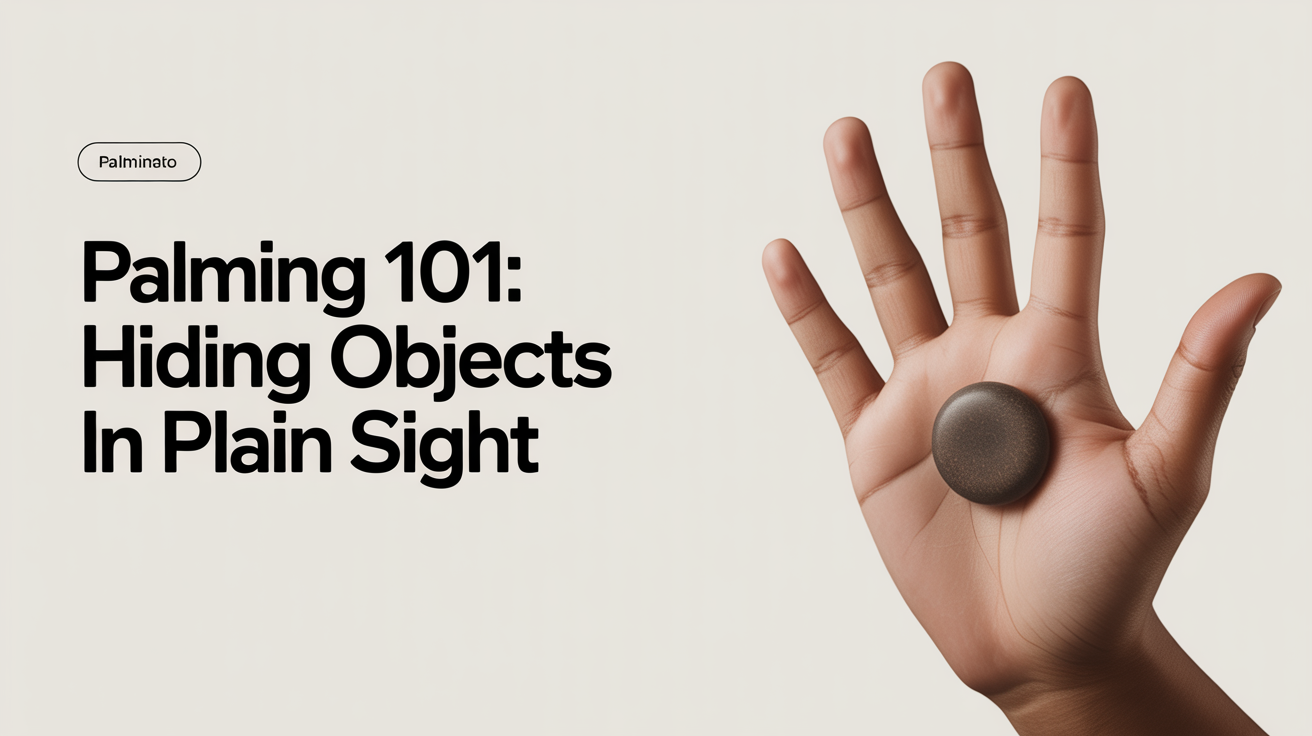
Pick up a small object (a coin, a sponge ball, a folded card) and close your fingers around it. Now relax your hand completely and let it hang at your side as if it holds nothing. If it looks casual and natural, you've just taken your first step into palming. If your hand looks stiff, clenched, or weirdly angled, you're doing what every beginner does. The good news is that's exactly what this guide is for.
Palming is not a single trick. It's a foundational skill that shows up everywhere in close-up magic, stage work, and even mentalism. Once you understand what a palm actually is and why it works, you'll start to see the principle operating beneath dozens of effects you already admire.
At a Glance
- Palming means secretly holding an object in a hand that still looks empty, relaxed, and ordinary; the technique matters more than which exact spot in the hand the object rests.
- There are four main palm types: finger palm, thumb palm, classic palm, and card palm, each suited to different objects and situations.
- A relaxed, consistently-used hand beats a perfectly hidden one. Tension and asymmetry give palms away far more often than a slightly visible edge does.
- Never look at your palmed hand. Where your eyes go, your audience's eyes follow, and research on eye movement during magic backs this up directly.
- Every palm has weak angles. Find yours in a mirror before you ever perform for a real person.
- Expect a basic finger palm to feel functional within weeks, and to feel truly invisible only after real performance pressure, not just solo practice.
What Palming Really Means
In everyday language, "palming" suggests hiding something in your palm. In magic, the word is broader. A palm is any method of secretly retaining an object in your hand while that hand appears empty, relaxed, and free. The idea has a long history in conjuring: Wikipedia's entry on palming describes it plainly as "a technique for holding or concealing an object in the hand," used across coin, card, and small-object magic alike.
The critical word is "appears." Your audience knows, on some level, that magicians hide things. What makes a palm work is not invisibility. It's that your hand looks so ordinary the thought of checking it never crosses their mind. Suspicion is the enemy of good magic, and a natural-looking hand kills suspicion.
This is why palming belongs to the same family of ideas as misdirection. The palm is a physical secret; misdirection is the psychological cover that keeps eyes where you want them. Cognitive scientists who study magic have made the same connection from the research side: a widely cited review in Trends in Cognitive Sciences frames magic as running on the ability to control attention, distort perception, and influence choice, which is a fair description of what a good palm plus good misdirection accomplishes together. Used together, they're remarkably powerful.
The Four Main Palm Types
Palms are named for where and how the object rests in the hand. Each has its strengths.
Finger Palm
The object sits in the curl of the middle two or three fingers, held by gentle flexion rather than grip. Your hand can hang, gesture, and turn palm-up without revealing anything as long as those fingers stay softly bent. The finger palm is considered one of the most natural-looking positions because slightly curved fingers are completely normal at rest. This is often the first palm beginners learn, and it works for coins, small balls, and rolled-up cards.
Thumb Palm
Here the object is pinched lightly at the base of the thumb, tucked into the webbing on the thumb side of the hand. The fingers can spread and the palm can face outward. It looks casual because people rarely study the inner corner of someone's hand. Thumb palm is particularly useful for vanishing small coins and for getting objects into position quickly.
Classic Palm
This is what most people picture when they hear the phrase. The object rests at the base of the fingers, held by a slight muscular contraction across the palm. No gripping, no squeezing: just a gentle tension that keeps the object from sliding. The hand can turn over and show its "empty" back, which is one of the classic palm's advantages. It requires a bit more practice to keep the hand looking loose, but the payoff is worth it. This palm is central to coin magic and many card productions.
Card Palm
Cards deserve their own category because their size demands a different geometry. In a card palm, one or more cards are held flat against the back of the hand or concealed at the heel of the palm. Done well, the hand waves naturally and the hidden card is invisible from the front. Card palming is what allows a magician to make a selected card "appear" from an impossible location. If you're curious about related card control techniques, the false shuffle is worth studying alongside this skill.
Choosing the Right Palm for the Job
With four options, it helps to know which one to reach for. This table compares them at a glance.
| Palm type | Object it suits | Concealment strength | Learning curve |
|---|---|---|---|
| Finger palm | Coins, small balls, rolled cards | Strong from most angles, weakest from below | Easiest; most beginners start here |
| Thumb palm | Small coins, quick transfers | Good from the front, weaker from the side | Moderate; angle-sensitive |
| Classic palm | Coins, small flat objects | Very strong, hand can show front and back | Hardest; requires real muscle control |
| Card palm | Playing cards | Strong from the front, requires careful hand orientation | Moderate; depends on hand size relative to card |
The Principles That Make Any Palm Work
No matter which type of palm you're using, the same set of principles applies. Nail these and every palm you learn will improve.
A Relaxed, Curved Hand
A tense hand is a dead giveaway. When people hold nothing, their fingers fall into a gentle curve, not splayed flat and not clenched. Whatever object you're palming, your goal is to make your hand look like it's holding nothing, which means it has to match the shape of a genuinely empty hand. Practice holding the object and then slowly releasing all the tension you don't need. You need just enough muscular engagement to keep the object in place. Everything else should relax.
Consistent Hand Position
Your empty hand and your loaded hand should behave identically. This is the part most beginners overlook. They walk around with a normal right hand and a slightly weird left hand, and that asymmetry draws the eye. Before you perform a palm for anyone, practice carrying the object around your house. Make tea, answer a door, gesture while talking. If the hand stays convincing through ordinary life, it will stay convincing on a stage.
Never Look at Your Palmed Hand
Eyes are magnetic. If you glance at the hand holding the secret, your audience will look there too. This sounds obvious and yet it is the single most common mistake in beginner palming. Researchers studying eye movement during magic tricks have found that even involuntary micro-movements of a spectator's eyes track where attention is actually directed, not just where a performer points it, which means your own eye contact is doing real work whether you're aware of it or not. One study measuring these tiny eye movements during a vanish trick found they could reveal the dynamics of misdirected attention frame by frame. Train yourself to look at the other hand, at your spectator's face, at whatever object you're producing or vanishing. The palmed hand exists only in your peripheral awareness.
Use the Hand Normally
A palmed hand that just hangs limply at your side looks suspicious in its own right. Use it. Point with it. Adjust your sleeve. Accept an object someone hands you and transfer it casually to the loaded hand. The more you use the hand in a natural way, the less reason anyone has to study it.
Angles and Awareness
Every palm has a position or two where the object would flash into view. Know yours. A finger palm is usually safe from the front but exposed from below. A classic palm can be vulnerable at certain side angles. Before performing for real people, stand in front of a mirror and slowly rotate. Find the danger zones. Then position yourself so those angles never face your audience.
Practical Drills for Building a Natural Palm
Knowing the principles is one thing. Owning them in your hands is another. These drills close that gap.
- The walk-around drill: Palm a coin or small ball and go about your normal day at home for fifteen minutes. Do dishes, type, open doors. Notice when the object wants to shift and learn to correct it without thinking.
- Mirror work: Stand in front of a full-length mirror and practice a simple vanish: object in hand, palm it, turn the hand over to show it empty, look at your face the whole time. The mirror tells you the truth your own perception can't.
- Idle hands: Practice getting the object into palm position smoothly and quickly, then letting your hand rest naturally for thirty seconds. Repeat. The transition in and out of the palm is where most flashes happen.
- Hand amnesia: This is the mental side. When you palm an object, tell yourself your hand is empty. Don't think about the object. Don't mentally protect it. Let your body move as if nothing is there. Performers who think too much about the secret give themselves away even without a visible flash. There's a quality of guardedness that audiences sense.
- The ten-minute conversation test: Palm a coin using a finger palm and hold a normal ten-minute conversation with a friend or family member without telling them. At the end, ask if they noticed anything odd about your hand. Most beginners are surprised how often the answer is no, which is a good confidence builder before performing for strangers.
How Palming Enables Effects
Palming is not an end in itself. It's infrastructure. Here's how it plugs into the effects you'll actually perform.
Vanishes: An object is seen in one hand, both hands are shown empty, the object has disappeared. The palm is how you get it out of sight between "seen" and "empty."
Productions: A hand that appears empty suddenly contains a coin, a card, a signed piece of paper. The object was palmed the whole time, waiting to be revealed.
Switches: You show object A, palm it, and produce object B in its place. The spectator thinks they watched the same object the whole time. Palmed switches are behind an enormous number of card effects and coin transpositions.
Once you can palm reliably, you'll find that sleight of hand stops feeling like a collection of separate tricks and starts feeling like a language. Palming is one of the most common words in that language.
Putting Palm Practice in Context
A note on the learning curve: palming feels awkward for longer than most beginners expect. The hand knows it's hiding something, and that knowledge leaks into your movement. The solution is time. Not just practice time, but performance time. There is no substitute for doing a palm in front of a real person who is actually trying to catch you. That pressure sharpens your awareness faster than any amount of solo mirror work.
Start with a finger palm of a coin. Get it to where you can carry it in conversation without thinking about it. Then try producing it casually: reach into a pocket and "find" nothing, then open the other hand to reveal the coin. Keep the effect small while the technique develops. Confidence in a small effect is worth far more than nervousness in a big one.
FAQ
How long does it take to learn to palm convincingly?
For a basic finger palm that holds up in casual conversation, a few weeks of daily practice is realistic for most people. A truly deceptive classic palm under real performance pressure takes longer: months of regular work, plus actual time performing for spectators. The skill compounds: each palm you learn makes the others easier because you're building the same underlying habits of relaxation and natural movement.
Can people with small hands palm effectively?
Yes. Hand size affects which objects palm most comfortably, but it doesn't prevent palming. Many skilled close-up magicians have smaller hands and simply choose objects and palm positions that suit their geometry. A finger palm of a smaller coin is often more deceptive than a classic palm of a large one precisely because the hand can stay more relaxed.
Is it okay to practice palming in public?
Practice the hand position and the naturalness in real-world settings. Yes, absolutely. But avoid practicing the full sleight in public where you might accidentally reveal the method to bystanders. The magician's code is a real and useful idea: keeping a technique private protects the experience for everyone who will eventually watch you perform. Practice in private, and perform with care.
What's the difference between palming and ditching?
A palm is an active concealment: the object stays in your hand. A ditch is when you deposit a secretly held object somewhere (a pocket, a table, another prop) during a moment of cover. Palming and ditching often work together: you palm an object to move it safely, then ditch it at the right moment to free your hand completely.
Do I need special props to start learning palming?
No. A standard coin works perfectly for learning finger palm and thumb palm. A playing card from any deck teaches card palming. Many performers spend years working with objects they found around the house before investing in specialty props. Start with what you have.
Which palm should a total beginner learn first?
Start with the finger palm of a coin. It has the gentlest learning curve of the four, tolerates the widest range of angles, and teaches the core skill, a relaxed hand shape, that every other palm builds on. Most beginners can move on to a thumb palm within a few weeks of comfortable finger palm practice, and save the classic palm for later once "relaxed while hiding something" feels automatic rather than effortful.