The Branches of Magic: Card, Coin, Close-Up, and Mentalism
Explore the main types of magic tricks — from card and coin magic to mentalism and stage illusions — and find the branch that's right for you as a beginner.
Magic is a broad art. When most people picture a magician, they picture someone in a tuxedo sawing a person in half. But the performer at your friend's dinner party who made a coin vanish and reappear from behind your ear is practicing magic too. They just live in completely different neighborhoods of the same city. Knowing the main types of magic tricks before you start learning helps you find your neighborhood faster, instead of wandering around buying props that don't suit you.
Here's a plain-language tour of the major branches.
The Main Branches of Magic at a Glance
Before diving into each category, here's a quick comparison so you can see the landscape at once.
| Branch | Core Props | Difficulty for Beginners | Best For |
|---|---|---|---|
| Card Magic | Deck of cards | Low to medium | Most beginners |
| Coin Magic | Coins (half dollars, quarters) | Medium | Hands-on learners who love sleight of hand |
| Close-Up / Everyday Object Magic | Rubber bands, pens, matches, borrowed items | Low to medium | People who want to perform anywhere, anytime |
| Stage / Parlor Magic | Large boxes, silks, assistants | High (cost and skill) | Performers ready for a real audience setup |
| Mentalism | Sealed envelopes, notepads, ordinary objects | Medium | Performers drawn to psychology and mystery |
| Comedy / Kids Magic | Colorful props, simple gimmicks | Low | Entertainers who want laughs as much as wonder |
| Street Magic | Cards, coins, everyday objects | Medium | Performers who love working with strangers |
Now let's spend real time with each one.
Card Magic
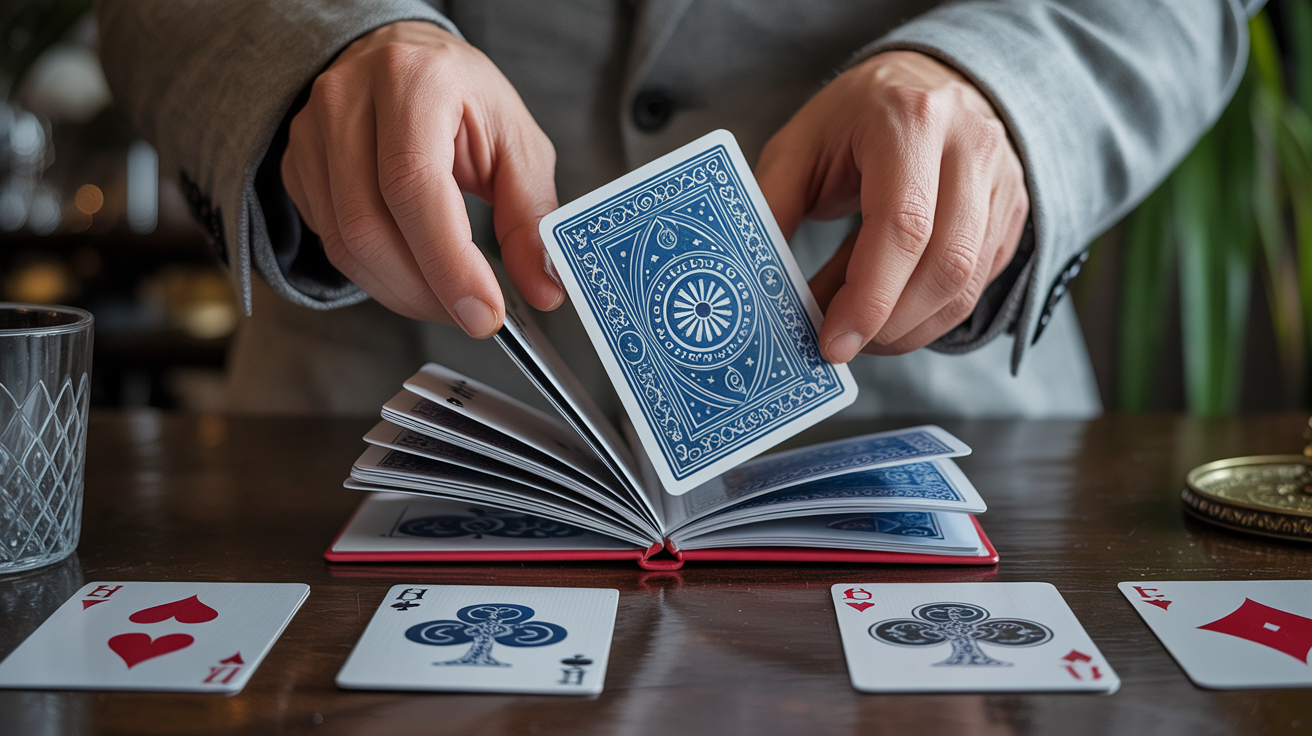
Card magic is where most beginners land, and for good reason. A single deck of playing cards costs almost nothing, fits in your pocket, and opens the door to thousands of effects. The audience already knows what a deck of cards looks like, so there's no setup required. You pull it out, and you're already in the game.
What Card Magic Feels Like
Card magic ranges from pure self-working tricks (where the math does the heavy lifting and you just follow the steps) all the way up to polished sleight of hand: false cuts, controls, palms, forces. A beginner can learn a genuinely fooling card trick in a single afternoon using a self-working method. That's a ramp-up curve that almost no other branch can match.
The Vibe
Intimate. Card magic tends to happen in someone's hands or on a table with a few people gathered around. The focus is sharp and personal. When a chosen card appears in an impossible place, the reaction is up close and immediate.
If you want a starting point, check out the beginner's guide to learning magic. It covers how to approach your first few tricks, including self-working card effects that give you real performing material fast.
Coin Magic
Coin magic has a devoted following, and it earns that devotion. There's something uniquely convincing about a solid metal coin vanishing from a closed fist or appearing under a glass that was sitting on the table the whole time. Coins are completely ordinary objects that everyone trusts, which makes the impossibility hit harder.
What Makes It Distinct
Coin magic is heavily technique-driven. The classic moves, like the French Drop, the Finger Palm, and the Retention Vanish, take real practice to make smooth. Your hands are always visible and always suspected, which means your technique has to be genuine. It's not a branch where shortcuts carry you very far.
That said, there are beginner-friendly coin tricks that use gimmicked coins or simple sleights that can be learned in a few sessions. The investment is in your hands more than your wallet.
The Vibe
Punchy. Coin tricks tend to be short and sharp. A coin vanishes. It reappears. The sequence is tight. That directness is part of the appeal. When it works, the clean impossibility is stunning.
Close-Up Magic and Everyday Object Magic
Close-up magic is less a specific prop category and more a performance setting. It covers any magic performed at close range, typically inches from the spectator, using small objects. Cards and coins both belong here, but so do rubber bands, matches, pens, borrowed dollar bills, sugar packets, and whatever else happens to be on the table.
Why Beginners Should Pay Attention
This is arguably the most practical branch for someone just starting out. You're not waiting for a stage. You're not hauling equipment. You learn a rubber band trick, and you can perform it tonight at dinner. That kind of low barrier to real performance is enormously valuable early on, because performing in front of actual people is where you learn fastest.
Self-working tricks shine especially bright in close-up contexts. A mathematical card effect performed with a borrowed deck, presented with a bit of story and personality, can fool people who have been around magic for years.
The Vibe
Casual and personal. Close-up magic thrives at parties, restaurants, small gatherings, and any moment where people are relaxed and together. The intimacy makes the reactions warm and genuine.
Stage and Parlor Magic
Stage magic is what most people picture when they imagine "a magician." Large illusions. A woman floated in midair. A tiger appears in a flash of light. This is the world of big productions, assistants, trapdoors, and serious infrastructure.
Parlor magic sits between close-up and stage: effects designed for an audience of perhaps twenty to a hundred people, without requiring a full theatrical rig. Think of a linking rings routine performed for a seated crowd, or a torn-and-restored newspaper effect.
How Beginner-Friendly Is It?
Honestly, stage magic is the hardest branch to start with. The equipment is expensive. The logistics are demanding. The learning curve on large-scale illusions is steep, and there's no easy way to practice the presentation without a real setup. Most professional stage magicians spent years in close-up and parlor work before moving to larger productions.
That doesn't mean you can't be fascinated by it from day one. But if you're just beginning, it's better to study it, appreciate it, and put your practice time into close-up work first.
Mentalism
Mentalism is magic of the mind. A mentalist appears to read thoughts, predict choices before they're made, and sense things that should be unknowable. The tools are ordinary: a sealed envelope, a notepad, a borrowed object. The performances often feel less like tricks and more like genuine paranormal experiences.
What Sets It Apart
Most branches of magic openly announce themselves as magic. Mentalism often doesn't. Many mentalists present their work as a demonstration of psychological insight or unusual perceptive ability rather than conjuring. That shifts the performance style completely. The patter is more conversational, the pacing slower, the mystery deeper.
The Learning Curve
Mentalism requires strong presentation skills. The technical methods behind many effects are not complicated, but making those methods invisible inside a believable performance takes real work. Understanding a little about psychology, cold reading, and how people think is a genuine advantage here.
For a beginner who's more interested in human psychology than in sleight of hand, mentalism is a natural fit. Just expect to spend as much time on your presentation as on the method itself.
To understand why protecting methods matters especially in mentalism, take a look at the magician's code. The commitment to secrecy is part of what makes the art form work.
Comedy and Kids Magic
Comedy magic is a genuine specialty, not just regular magic with jokes added on. The best comedy magicians are crafting two things at once: a surprise for the mind and a laugh for the room. Props in this branch tend to be colorful, exaggerated, and designed for visibility.
Kids magic lives in similar territory. Effects need to be visually clear, fast, and built for short attention spans. The reaction you're going for is laughter and delight, not quiet awe.
Is It a Good Starting Point?
For the right personality, absolutely. If you're naturally funny and comfortable performing for children or family gatherings, this branch gives you a real performing context immediately. The technical bar is often lower because the audience is more forgiving, though building genuine comic timing is its own art.
Street Magic
Street magic uses the same tools as close-up magic, primarily cards and coins, but changes one major variable: the audience is strangers. There's no social contract. People can walk away. Getting someone to stop, engage, and then react genuinely is a skill that goes well beyond the trick itself.
Street magic became culturally prominent in the late 1990s and early 2000s, an era shaped in large part by David Blaine's televised street specials, and changed how a lot of people think about what magic can look like. It's raw, immediate, and the reactions are unscripted.
Starting Out With Street Magic
Most magicians who do street work well have already put in years of close-up practice in friendlier settings. Learning to perform for strangers is a real skill on top of the magic itself. If you're drawn to this branch, start by mastering a small set of close-up tricks in front of friends and family first. The confidence you build there is what makes approaching strangers feel manageable.
Where Should a Beginner Start?
Close-up card magic using self-working tricks. That recommendation comes up again and again because it's genuinely correct. The props are cheap, the learning curve is gentle, the first performing opportunities are immediate, and the branch gives you the best foundation for anything you want to do later.
Coin magic is a strong second choice if you're interested in sleight of hand from the beginning. Mentalism is worth exploring early if psychology interests you more than props. Stage magic is something to study and admire while you build your skills elsewhere.
Whatever branch draws you in, the advice is the same: learning magic is a gradual process, and your first job is to get one or two tricks performance-ready before adding more. Depth beats breadth, especially at the start.
FAQ
Which type of magic is easiest to learn?
Close-up card magic using self-working tricks is generally the most accessible starting point. Self-working effects rely on mathematical or mechanical principles rather than sleight of hand, so a complete beginner can learn a genuinely fooling trick in one sitting. From there, you build technique gradually rather than needing it all upfront.
Do I need expensive props to get started?
For most branches, no. A standard deck of playing cards or a few coins from your pocket is enough to begin. Stage and parlor magic eventually involve more investment, but card, coin, close-up, and even mentalism can be learned with minimal equipment.
What's the difference between close-up magic and stage magic?
Primarily the scale and setting. Close-up magic happens inches from your audience using small objects. Stage magic is designed for larger spaces, theaters, event venues, and uses bigger props, assistants, and sometimes theatrical infrastructure. The underlying principles of misdirection and surprise are the same; the presentation and logistics are completely different.
Is mentalism the same as magic?
Mentalism uses the same core principles as magic: method concealment, misdirection, timing, presentation. But it tends to be performed under a different frame. Many mentalists don't present themselves as magicians; they present as demonstrating psychological insight or heightened perception. The distinction is mostly about performance style rather than fundamentals.
Can I learn multiple branches at once?
You can, but most experienced magicians suggest picking one and going deep before branching out. Learning two or three tricks from ten different categories leaves you with nothing performance-ready. Learning ten tricks in one branch gives you a real act. Once you have a foundation, adding from other branches becomes much easier.