5 Easy Magic Tricks Anyone Can Learn Today
Learn 5 easy magic tricks for beginners using everyday objects. Step-by-step methods for cards, coins, rubber bands, and more — no experience needed.
You do not need a magic shop, a special kit, or years of practice to fool someone today. The five tricks below use cards, a coin, a rubber band, two paperclips, and a folded bill, things most people have within arm's reach. Each one teaches a real principle that professional magicians use. Master these and you will have built a genuine foundation, not just a collection of novelties.
If you are brand new to the hobby, our beginner's guide to learning magic lays out how to build a practice routine. When you are ready to go deeper into self-working methods like the ones here, is magic hard to learn? is worth reading before you judge yourself too harshly at the start.
At a Glance
- Five tricks, five different principles: the key card (card location), the French Drop (coin sleight), the jumping rubber band (a load hidden in a fist), the linked paperclips (pure physics, no skill needed), and the one-ahead prediction (a force called equivoque).
- Two of the five, the key card and the linked paperclips, work correctly the very first time you try them. The other three need mirror practice before they look convincing.
- All five use household objects. Nothing here requires a purchase from a magic shop.
- Perform each trick once per audience, twice at most for the rubber band or French Drop if you vary the presentation. Repetition is how methods get caught.
- Together these five touch card work, coin work, mentalism, and self-working tricks, the four branches most beginners eventually specialize in.
1. The Key Card: Find Any Card They Chose
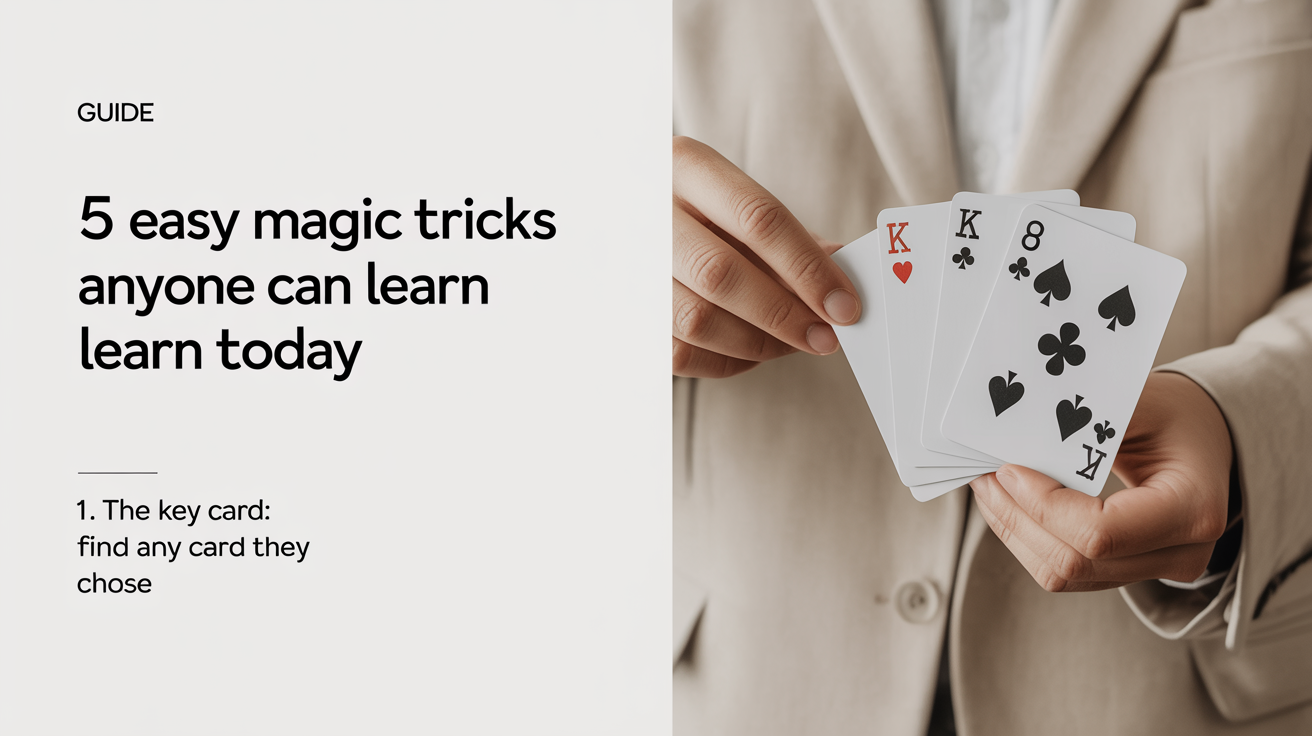
The effect: A spectator picks a card, loses it in the deck, and you find it instantly, without asking a single question.
Why this works: You secretly know one card (called the "key card"). When their chosen card lands next to yours in the deck, you can locate theirs by finding yours.
Step 1, Glimpse the bottom card
Before you start, casually glance at the bottom card of the deck. Do this while you are squaring the deck or lifting it off the table. Remember that card. That is your key card.
Step 2, Have them choose a card
Spread the deck face-down and ask someone to take any card. Let them look at it and remember it while you hold the rest of the deck.
Step 3, Place their card on top, cut the deck
Ask them to put their card back on top of the deck. Now give the deck one clean cut. This moves your key card from the bottom directly on top of their card. Their chosen card is now sitting right below your key card, somewhere in the middle.
Step 4, Spread and find
Ribbon-spread the cards face-up on the table, or slowly fan through them. When you spot your key card, the card immediately to its right (or below it in the spread) is their card. Hesitate for a moment, "read" the audience dramatically, then pull it out.
Patter: "I don't need to see which card you took. I just need to feel the energy shift in the deck."
This trick teaches you the concept of the key card, which is one of the most important building blocks in card magic. You can read more about how this principle extends into dozens of other effects.
2. The French Drop: Make a Coin Vanish Into Thin Air
The effect: You take a coin between your fingers and thumb, close the other hand over it, blow on your fist, and the coin is gone.
The method: The coin never actually goes into the second hand. You pretend to take it but secretly let it fall into your palm.
How to do the French Drop
Hold the coin between the thumb and first two fingers of your left hand, with the coin facing toward the audience. Bring your right hand over as though you are pinching the coin to take it. At the moment your right fingers close over the coin, let the coin drop quietly into your left palm and curl your left fingers loosely to keep it hidden. Your right hand closes as if it holds the coin, but it is empty.
Raise your right fist to eye level, draw attention to it, blow on it, then slowly open your fingers. Empty. The coin has "vanished." You can then "reproduce" it from behind someone's ear by simply opening your left hand and producing the palmed coin in a natural way.
Patter: "Coins have a habit of going where they want to. This one just got impatient."
The French Drop takes a week or two of mirror practice before it looks clean. Go slowly. The move only needs to be believable for about half a second. Like most coin and card sleight of hand, the fine-motor precision matters far more than raw speed, a slow, natural-looking take reads as more honest than a fast, jerky one.
3. The Jumping Rubber Band
The effect: A rubber band rests visibly on your first two fingers. You close your fist, open it, and the band has leapt to your other two fingers, completely unexplained.
This one is genuinely baffling when done smoothly, and the whole method is performed in plain sight in about a second.
The setup
Place a rubber band over your first and second fingers (index and middle), sitting at the base, near the knuckles, on the back of your hand.
The secret move
Curl all four fingers into a loose fist with your palm facing you. In that moment, before anyone can see inside the curl, use your other hand or simply stretch the band slightly and slip all four fingertips inside the band. Your fingertips are now inside the loop, but from the front this is invisible.
The jump
Open your hand quickly, straightening all four fingers at once. The band snaps forward and lands around your ring finger and pinky. From the audience's view, it simply jumped.
Patter: "Rubber bands obey different laws of physics when they're showing off."
Practice the curl-and-load in front of a mirror until you can do it in one fluid motion. The speed of the "open" matters more than the setup, a quick snap makes the jump look impossible.
4. The Linked Paperclips
The effect: You fold a dollar bill (or any banknote) into a Z-shape and clip two paperclips onto it in specific spots. You pull both ends of the bill sharply. The paperclips fly into the air, and land linked together.
This is a self-working miracle. No sleight of hand at all. The geometry of the fold does everything.
How to set it up
Fold the bill into a Z or S-shape: fold the left third of the bill back toward you, then fold the right third forward away from you. Viewed from above, the bill forms a rough Z.
Clip the first paperclip onto the front layer and the middle layer, near the left-center of the fold. Clip the second paperclip onto the back layer and the middle layer, near the right-center of the fold.
The payoff
Hold one end of the bill in each hand and pull sharply outward to unfold it. The two paperclips will pop off the bill and, almost every time, land together linked through each other.
Patter: "Two strangers, introduced by physics. They had no say in the matter."
Experiment with the exact placement of the clips, positioning them closer to the center tends to produce a reliable link. The bill needs a decent amount of stiffness, so a stiffer banknote works better than a limp one. If your first few attempts fail to link, check that both clips sit on the folded layers rather than slipping onto a single layer; that single mistake accounts for most failed attempts.
5. The One-Ahead Prediction
The effect: Before anything happens, you write a prediction on a piece of paper and set it aside. A spectator makes a completely free choice. When they open the prediction, you were right.
The principle: A force. Rather than predicting what they will choose, you secretly steer their choice toward what you already wrote. This particular structure, using a series of either/or choices to steer someone toward a predetermined outcome, is called equivoque, or the magician's choice, and it is one of the most widely used forcing methods in all of magic.
The simplest force: the equivoque (magician's choice)
Write the word "RED" on a folded slip of paper and set it aside without showing anyone.
Place two objects in front of your spectator, one red, one blue. Ask them to point to one. If they point to the red one: "Great. Open the prediction." If they point to the blue one: "Perfect, we'll set the blue aside." Either way, you end up with the red object, and your prediction matches.
This is the basic structure of equivoque, also called the magician's choice. With two objects it is fairly transparent, so use it for something where the "force" feels less suspicious, a number between one and three, a suit of cards, a color. Practice your phrasing so both outcomes sound equally deliberate.
Patter: "I wrote this before I even knew what you'd choose. Go ahead, read it out loud."
The strength of this trick is presentation. Your confidence in the moment matters more than the method. Commit fully to it.
Which One Should You Learn First?
| Trick | Skill required | Ready to perform | Learn it because |
|---|---|---|---|
| Linked Paperclips | None, pure setup | Immediately | Guaranteed success builds confidence fast |
| The Key Card | None, just memory and timing | Immediately | Teaches the single most useful principle in card magic |
| The One-Ahead Prediction | Scripting and delivery | A day or two | Teaches forcing, the backbone of mentalism |
| The Jumping Rubber Band | Light sleight of hand | About a week | Teaches loading something secretly in a closed fist |
| The French Drop | Real sleight of hand | One to two weeks | Teaches the false transfer, used in dozens of coin effects |
If you only have time to learn one thing this week, start with the linked paperclips or the key card. Both are mechanically reliable, so any rough edges in your first few performances will be about presentation, not the method failing on you.
FAQ
Do I need any special equipment for these tricks?
No. The key card trick uses a regular deck of playing cards. The French Drop uses any coin. The jumping rubber band uses a standard rubber band. The linked paperclips use two paperclips and a bill. The prediction trick uses a pen, paper, and two small objects. Nothing needs to be gimmicked or purchased from a magic shop.
How long will it take to learn these?
The paperclip trick and the key card trick work on the first try, the method is mechanical. The prediction trick requires a little scripting but no physical skill. The French Drop and the rubber band jump both need about a week of daily mirror practice before they look convincing. Set aside ten minutes a day and you will be ready to perform all five within two weeks.
Can I perform these tricks multiple times for the same person?
Repeat the prediction trick or the linked paperclips once at most. Card tricks lose their power quickly with the same audience. The rubber band and French Drop can hold up a second time if you add variety, but the general rule is: perform each effect once, leave them wanting more, and move on. Part of the craft is knowing when to stop.
Am I supposed to reveal how these tricks work?
No. The magician's code is not just tradition, it is practical. Once someone knows the method, the experience is ruined, and they will spoil it for others. Keep the method private, practice seriously, and perform with care. You are giving people a moment of genuine surprise; that is worth protecting.
What should I learn after these five tricks?
These five effects touch four different areas of magic: card work, coin work, mental magic, and what performers call "self-working" tricks. From here, explore each branch that interests you. Card handling opens a deep world of technique. Coin magic rewards precise sleight-of-hand. Mentalism leans heavily on presentation and psychology. Knowing the different branches of magic will help you decide which direction feels right for you.
Why do the linked paperclips work every time?
It comes down to how the fold layers the bill. When you pull the ends apart, the middle section of the bill has to snap through both clips as it straightens, and the geometry of the Z-fold forces the clips to catch each other's loops in that instant rather than simply flying apart. It is closer to a small mechanical puzzle than a magic secret, which is exactly why it needs no practiced skill to succeed.
What is the single biggest reason a beginner gets caught doing one of these?
Performing before the method is genuinely automatic. Every sleight in this list, the French Drop especially, needs to happen without you thinking about your hands at all so your face and attention stay with the audience. If you catch yourself glancing down at the critical moment, that is a sign to practice longer in the mirror before showing anyone, not a sign the trick itself is flawed.