Coin Palming Basics for Beginners
Learn how to palm a coin with the finger palm and thumb palm. Step-by-step instructions for beginners, plus practice drills and common mistakes to avoid.
Palming a coin is the foundation that almost everything else in coin magic is built on. Before you can make a coin vanish, produce one from thin air, or link it into a sequence of moves, you need to be able to hold a coin invisibly in a hand that looks completely relaxed and empty. That is palming. It is not a trick by itself. It is the invisible infrastructure underneath your tricks, and once it clicks, a huge range of coin magic opens up to you.
The good news: you do not need large hands or unusual dexterity. You need the right technique and a lot of casual, low-pressure practice.
At a Glance
- Palming means secretly holding a coin in a hand that still looks natural, relaxed, and empty. It is a foundation skill, not a trick on its own.
- Start with the finger palm. It is the most natural-looking hold and the easiest for beginners to keep relaxed under pressure.
- The thumb palm comes second, useful when your fingers need to spread openly toward the audience.
- Save the classic palm for later. It is the cleanest-looking hold but demands real muscle control most beginners haven't built yet.
- A quarter is the standard practice coin: heavy enough to feel, common enough to always have on hand.
- Expect the physical hold to feel functional within hours, but plan on weeks of regular daily practice before it holds up under real performance pressure.
What Palming Actually Is
Palming means secretly retaining a coin in your hand while your hand appears natural and open to the audience. The word "palm" is a little misleading for beginners, because the coin is not always resting in the center of your palm. Different palms use different parts of the hand: the fingers, the base of the thumb, the heel. Each has its own advantages.
The goal is always the same: a coin is in your hand, and nobody can tell. Your hand hangs at your side, gestures normally, or picks up another object, and no one notices anything hidden inside it. The moment your hand tenses up or curls into an obvious claw shape, the illusion collapses.
Before going further: palming is a technique for performance, not for theft. The magician's code means we keep secrets to preserve the wonder of the performance, and we practice privately with care. Keep your practice between you and the mirror.
The Finger Palm (Start Here)
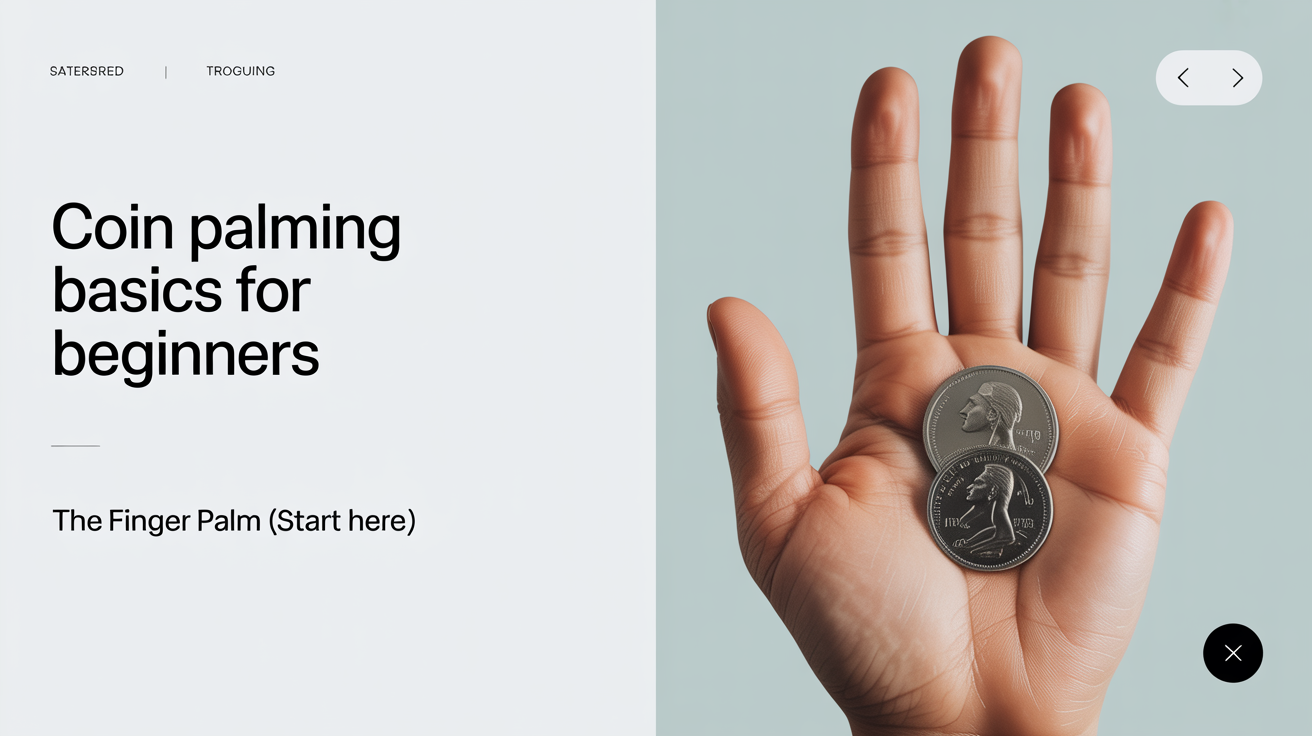
The finger palm is the first palm most beginners should learn. It is the most natural-looking of the basic holds, and the easiest to keep relaxed under pressure.
How the Finger Palm Works
Hold a coin between the first and second joints of your middle and ring fingers. The coin sits in a small groove created by those two fingers curling very slightly inward. Your hand does not need to close dramatically. The fingers just curl a little, as they would if you were loosely carrying something or walking with your arms at your sides.
Step-by-Step Setup
- Start with a quarter or similarly sized coin lying flat in your palm.
- Let your middle and ring fingers curl gently inward until they contact the coin.
- Apply just enough pressure to grip it. No white knuckles, no tension in the thumb or index finger.
- Let your hand hang at your side and look at it in a mirror. It should look unremarkable.
- Try extending your index finger naturally, as if pointing at something. The coin should stay put.
Keeping the Hand Natural
This is where most beginners struggle. After you load the finger palm, the instinct is to freeze. Do not freeze. Let your hand move. Swing it at your side. Gesture with it while you talk. Pick up a coin from the table with the other hand. The finger palm is secure enough to survive gentle, natural movement.
The enemy of a good palm is self-consciousness. When you know a coin is hidden there, your brain sends signals to protect it, so you tighten, you hold still, you avoid moving that hand. Fight that impulse. A slightly stiff hand reads as suspicious even if the audience cannot say exactly why.
The Thumb Palm
The thumb palm is slightly more specialized than the finger palm, but it comes up often, especially in moves where you pretend to pass a coin from hand to hand.
How the Thumb Palm Works
The coin is clipped at the base of the thumb, held between the fleshy pad at the base of the thumb and the top of the palm. The thumb itself sits relaxed alongside the hand, not pressing hard against the coin. The coin is held by the natural squeeze of that soft tissue, not by active gripping.
Step-by-Step Setup
- Hold a coin at your fingertips.
- Bring it back toward the thumb crotch, the area where the thumb joins the hand.
- Allow the base of the thumb to close slightly, trapping the coin against the palm.
- Let your fingers spread naturally. The coin should not be visible from the front.
- Try turning your hand so the back faces the audience. With a relaxed hand, the thumb palm is well-concealed from most angles.
When to Use the Thumb Palm
The thumb palm shines when you extend your fingers openly toward the audience while something is supposedly passing between your hands. Because your fingers can splay wide, the hand looks more convincingly empty than with the finger palm. The trade-off is that the thumb palm is a bit more angle-sensitive. Keep your palm angled slightly away from anyone standing at your side.
The Classic Palm (A Word for Later)
Once the finger palm and thumb palm feel solid, you will encounter the classic palm. This is the move where the coin sits flat in the center of the palm, held by the contraction of the palm muscles themselves. It requires more muscle control and more time to make look natural.
The classic palm produces a very clean look when done well. The hand can even be shown back and front in some contexts. But it demands dedicated practice to keep the hand from clenching, and beginners who rush to it often develop a stiff, suspicious hand position. Build your finger palm first. The classic palm will make more sense once you understand what "natural" actually looks like under pressure.
A Four-Week Starting Schedule
Beginners often ask how to sequence practice so it actually builds instead of feeling scattered. This is a reasonable default schedule; slow it down if any week feels rushed.
| Week | Primary focus | Daily drill | Goal by week's end |
|---|---|---|---|
| 1 | Finger palm, static hold | Load and hold for 60 seconds, five times a day | Coin sits securely without white-knuckle grip |
| 2 | Finger palm, movement | Daily-life drill: hold the palm through one everyday task | Coin survives walking, gesturing, opening doors |
| 3 | Thumb palm basics | Load-and-transfer drill between hands | Thumb palm holds through a hand turn and finger spread |
| 4 | Combine and perform | Run the French Drop using your finger palm, in front of a person | Someone watches and does not spot the method |
Practice Drills That Actually Work
Reading about palming and doing palming are different things. Here are the drills that accelerate real progress.
Mirror Work
Set up a mirror at eye level and practice loading each palm while watching your hand from the audience's perspective. You are not looking for the coin. You are watching for tension, unusual angles, and stillness that does not match how a hand normally looks. If something catches your eye, it will catch theirs.
The Daily-Life Drill
Load a finger palm with a coin and keep it while you do something mundane: pour a cup of coffee, read for five minutes, fold laundry. This is not about being sneaky. It is about teaching your hand to relax around a hidden object. The moment holding a coin stops feeling strange, your hand stops broadcasting that something is there.
The Gesture Drill
Practice your most natural, expressive gestures while maintaining a palm. Think of how you talk with your hands when explaining something to a friend. Talk out loud if it helps. The goal is to disconnect "there is a coin in my hand" from "I am behaving oddly." When the two things feel completely separate, you are making real progress. This is really a drill in misdirection as much as it is a drill in palming: an animated, expressive hand gives the audience nothing to fixate on, while a still, careful one invites exactly the scrutiny you're trying to avoid.
The Load-and-Transfer Drill
Practice loading the palm from various positions: from a table surface, from your other hand, from a pocket. The load (getting the coin into the palm) is often where the move gets detected. A tiny hesitation or a flicker of concentration on your face can give it away. Repetition smooths it out.
How Palming Connects to Vanishes
Once you have a working finger palm or thumb palm, you have the engine that powers most basic coin vanishes. The French Drop, for example, is a sleight where one hand appears to take a coin from the other, but the coin actually stays behind in the original hand, loaded into a palm.
Part of why a good vanish fools people so completely is a perceptual effect that goes beyond simple misdirection. Researchers studying vanish effects have found that spectators experience the space where an object used to be as genuinely, compellingly empty, an effect distinct from just failing to track where your attention was pointed. One study found that tricks built on this "illusion of absence" stayed difficult to solve even after participants watched them several times in a row, which is a good reminder that a clean palm plus a convincing "empty hand" gesture is doing real perceptual work, not just fooling attention for a moment.
You can read more about that specific move in the guide to how to do the French Drop coin vanish. The French Drop and the finger palm are natural partners; many beginners learn them together.
For a broader look at where coin palming fits into a full coin routine, the introduction to coin magic for beginners covers the landscape of entry-level coin work and helps you sequence these skills in an order that builds on itself.
Once you can vanish a coin reliably, the next step is bringing it back. That is covered in detail in the guide to how to make a coin vanish and reappear.
Common Mistakes Beginners Make
Knowing what goes wrong is half the fix.
Gripping too hard. Tension travels from your hand up through your wrist and into your whole demeanor. If your hand aches after a few seconds, you are squeezing. Ease off. A proper palm requires surprisingly little pressure once your hand position is correct.
Freezing the palming hand. A still hand is a suspicious hand. Move it. Give it something to do. Let it gesture, let it rest on the table, let it hold a glass. The coin is secure, so trust the hold and keep moving.
Angle blindness. Every palm has weak angles. The finger palm is relatively forgiving, but someone standing directly above you or to your extreme side will see more than the person in front. Know where your audience is. Perform face-on when you are still building confidence.
Rushing the load. The moment you load a coin into a palm is the most exposed moment in the sequence. Slow it down and attach it to a natural gesture, like a casual turn of the wrist or a shift of weight, so it is invisible inside larger movement.
Practicing only at the table. Palm work done only while sitting looks different than standing, arms at sides, in front of people. Practice standing up, with your hands in natural resting positions.
FAQ
How long does it take to learn to palm a coin convincingly?
The finger palm can feel functional within a few hours of focused practice. Performing convincingly in front of people without your hand giving anything away takes longer, typically weeks of regular daily drilling. The physical hold comes quickly. The relaxed, natural presentation takes time.
Do I need big hands to palm a coin?
No. Hand size is much less important than technique and relaxation. Plenty of skilled coin workers have average or even small hands. The coin does not disappear into your palm; it hides against your skin. What matters is how naturally your hand moves, not how much of the coin your hand covers.
What is the best coin to practice with?
A standard quarter is the most common choice. It is heavy enough to feel in your hand, common enough that you will always have one, and sized to work with most of the foundational moves. Some beginners find a half-dollar easier because the larger surface is easier to grip. Avoid very small coins while learning; they are harder to feel and control.
Will people look at my hands the whole time?
Not if you direct their attention elsewhere. A big part of performing any coin magic is misdirection, giving the audience something more interesting to look at than your hands at the moment the secret move happens. As you get comfortable with palming, you will start to notice natural moments in a routine where attention naturally shifts. Those are your windows.
Should I tell the audience I am palming a coin?
Never. The whole point of a palm is that the audience does not know a coin is in your hand at all. If someone asks whether you are hiding something, stay relaxed, keep your hands moving naturally, and redirect. Never confirm or deny in a way that draws more attention to the hand. A confident performer who keeps things moving will rarely be asked.
How many coins should I own while learning?
One is enough to start, but two identical coins open up more of coin magic sooner, since several classic routines rely on the audience believing there is only one coin in play when there are actually two. Buy a small roll of quarters from any bank; they are cheap, identical, and give you plenty of spares if one gets lost under a couch.
Is it normal for my hand to cramp while practicing?
A little fatigue after a long session is normal, especially in the first couple of weeks. Real cramping or pain is a sign you are gripping too hard rather than holding the coin with the light tension the finger palm actually needs. Shake your hand out, take a break, and check your grip in the mirror before continuing. Palming should never hurt.