How to Make a Coin Vanish and Reappear
Learn how to make a coin disappear and reappear with this beginner-friendly routine combining a vanish, a palm, and a surprise reproduction.
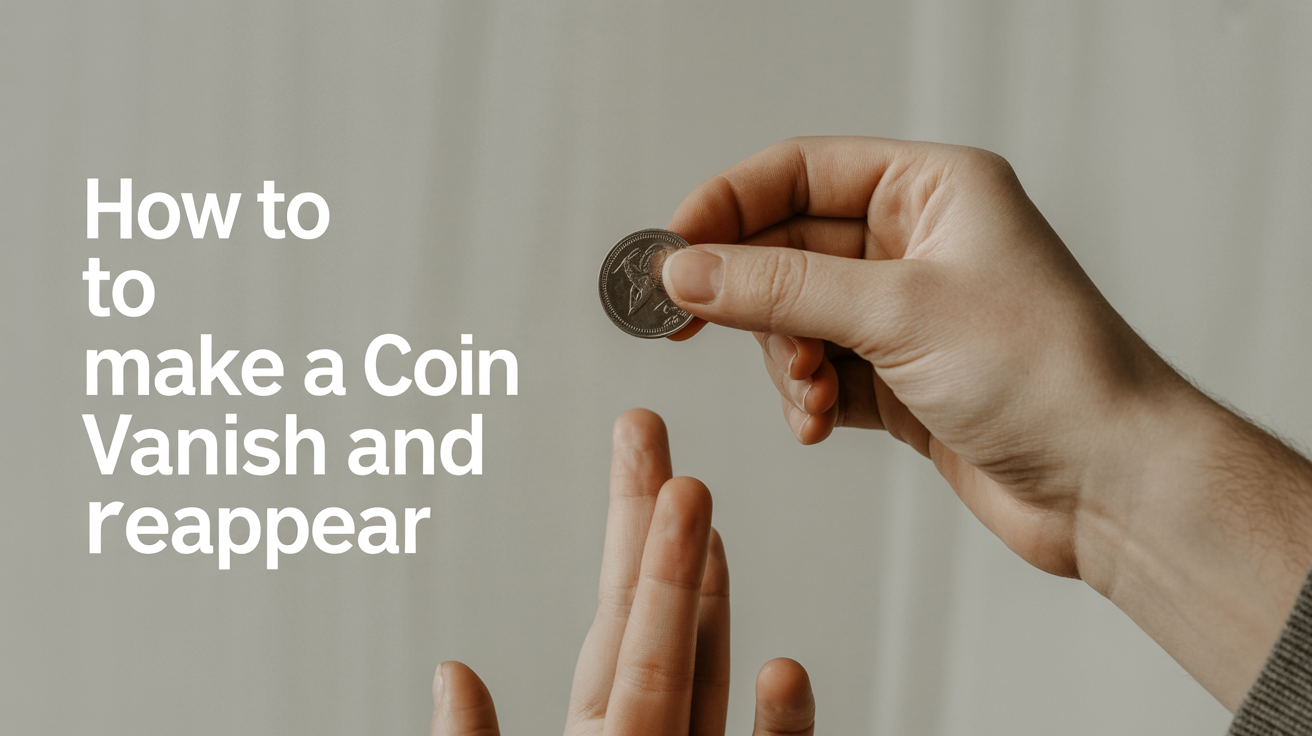
A coin is the perfect prop for a first magic trick. You always have one nearby, your audience already trusts it as an ordinary object, and a single coin can carry a complete story: it's here, it's gone, and then... wait, is that it behind your ear? This guide walks you through a beginner routine that combines a clean vanish with a satisfying reproduction. You'll learn the sleight that hides the coin, the misdirection that sells the moment, and the patter that wraps everything together.
What You Need Before You Start
You need one coin. A half-dollar or a large quarter works best because it sits more naturally in the hand and is easier for your audience to track visually. If you're practicing indoors, a 50-cent piece is ideal; a regular quarter will do fine.
Beyond the coin itself, you need two things that no prop shop can sell you: a bit of patience and a mirror. Every move in this routine looks foolproof in your head and falls apart the first time you catch yourself in a reflection. Practice in front of a mirror until the mechanics feel automatic, then start performing for people.
A Note on the Magician's Code
The techniques in this routine are public-domain moves that have been taught in beginner books for generations. Even so, part of what makes magic worth learning is the tradition of not spoiling it. Practice in private. Perform with care. Once you've done the trick for someone, don't immediately offer to do it again. The second viewing is when secrets get spotted.
The Two Phases of the Routine
This routine has a simple structure: a vanish and a reproduction. Each phase has its own job.
The vanish makes the coin disappear from one hand while the other holds it in secret. The reproduction reveals the coin in an unexpected place: behind a spectator's ear, plucked from the air, or produced from under their elbow. The moment between those two phases, when both hands appear empty, is the peak of the trick. Everything before it builds tension; everything after releases it.
Understanding the structure before you learn the individual moves helps enormously. You're not memorizing a series of steps. You're telling a short story with a beginning, a twist, and a punchline.
The Palm: The Engine That Connects Both Phases
The secret that links the vanish to the reproduction is a hold called the finger palm. When you finger-palm a coin, it rests in the crook of your two middle fingers while your hand hangs naturally at your side. Done well, no one looking at the front of your hand can see it.
To get into a finger palm, hold the coin at your fingertips with your palm facing up. Curl your middle two fingers inward until the coin rests in the crease where your fingers meet your palm. Let your other fingers fall naturally. Now turn your hand over so the palm faces down. The coin stays put, hidden by the slight natural curl of your fingers.
Spend time just walking around with a coin in finger palm. Put it in, take it out, put it in again. Your goal is a hand that looks completely relaxed whether it's holding a coin or not. If your fingers are stiff or clenched, the audience won't know why, but they'll feel that something is off. For a deeper look at this skill, see coin palming basics for beginners.
Step-by-Step: The Full Routine
Here is the routine from first display to final reproduction.
-
Display the coin. Hold the coin at your fingertips, between your right thumb and first two fingers, palm facing your audience. Let them see it plainly. Say something simple: "Just an ordinary coin. Take a look."
-
Set up the vanish. Bring your left hand across your body, palm up, as if you're going to drop the coin into it. Your right hand moves toward the left, coin visible between the fingers.
-
Execute the vanish. As your right thumb and fingers appear to drop the coin into the left hand, your right fingers curl inward and retain the coin in a finger palm. Simultaneously, your left hand closes as if it just received something. The coin never actually transfers, but every visual cue (your eyes, your body language, the motion of both hands) says that it did.
-
Misdirect with your gaze. Look at your closed left fist. This is critical. Wherever you look, your audience looks. If you glance at your right hand, you've just pointed at the secret. Keep your eyes locked on the left fist as if the coin is definitely in there.
-
Build a beat of suspense. Say something brief: "I want you to really focus on this hand." Then gesture casually toward your closed left fist with your right hand (the one hiding the coin). That wave gives your right hand a natural reason to move without drawing attention.
-
Show both hands empty. Open your left hand slowly, fingers spreading wide. Nothing there. Pause. Then turn your right hand palm-out with fingers loose, coin still hidden in the finger palm. From the front, both hands appear empty. This is the climax of the vanish phase. Hold the moment for one beat longer than feels comfortable.
-
Reproduce the coin. Reach toward your spectator's ear (or shoulder, or the air just beside their head) with your right hand. As your fingers approach, use your thumb to push the palmed coin up to your fingertips. Pinch it there and draw your hand back slowly, coin now visible. Say: "That's strange. It's been sitting right here the whole time."
-
Hand it over. Offer the coin for examination. It's just a coin. They'll check. That's the point.
Selling the Vanish: Misdirection and Timing
The sleight of hand in step three is only half the trick. The other half is everything you do to make it invisible.
The most important tool you have is your gaze. When you look at your left hand after the apparent transfer, your audience does the same, and they stop watching your right hand. That's exactly when you need them to stop watching it. Practice shifting your gaze the moment the coin is retained, not a half-second later.
Timing matters just as much. The vanish should feel unhurried. A nervous or rushed motion telegraphs that something is happening. Slow down more than you think you need to, especially in steps two and three.
Your patter also does real work. Phrases like "watch this hand closely" function as a stage direction. You're telling the audience what to pay attention to, which is a polite way of telling them what not to pay attention to. Keep it conversational. Scripted patter sounds memorized; loose, natural talk sounds like you're just thinking out loud.
Common Mistakes (and How to Fix Them)
Flashing the Coin
Flashing means letting a bit of the hidden coin become visible. Usually the edge catches light for a split second, or a finger shifts and exposes the coin's face. The fix is almost always the same: your grip is too loose, or your fingers aren't relaxed enough. A tense hand moves unpredictably. Practice the finger palm until the coin feels stable even when your hand moves freely.
Rushing the Reproduction
The reproduction is the payoff, and beginners rush it. They've been holding the palmed coin for fifteen seconds and want to get it out of their hand. Resist this. The longer you hold the empty-hand display in step six, the bigger the surprise when the coin appears. Count one beat after both hands are shown open, then go.
Looking at the Wrong Hand
Wherever your eyes go, theirs go. If you glance at your right hand after the vanish, even for a fraction of a second, you've created suspicion. Film yourself practicing to catch this. Almost everyone does it at first without realizing.
Moving Too Close to the Ear
When you produce the coin "from behind the ear," you don't need to actually touch the spectator. Reach toward their ear, produce the coin a few inches away, and then draw it back. Getting too close means fumbling, which breaks the moment. Keep a comfortable distance.
Practice Tips
Start by drilling the vanish alone: no reproduction, no patter, just the transfer motion and the finger palm, until it looks identical to an actual coin drop. If your practice vanish and your real coin drop look different, your audience will notice. They won't know why; they'll just feel a flicker of something.
Once the vanish is solid, add the reproduction. Practice the whole routine end-to-end at least twenty times before you perform it for anyone. By performance time, you shouldn't be thinking about the mechanics at all. You should be thinking about the person in front of you.
When you're ready to try it on a real audience, start with someone relaxed and friendly: a family member or a patient friend. Notice what they react to. The moment when their eyes go wide is information. That's where the magic actually lives in your routine.
For more context on where this trick fits in your learning path, see coin magic for beginners. And if you want to swap the finger palm vanish for a different method, how to do the French drop coin vanish covers a classic alternative that some beginners find more intuitive.
FAQ
How long does it take to learn this routine?
Most beginners can get through the full routine with reasonable confidence in one to two weeks of daily practice, around ten to fifteen minutes a day. The finger palm and the vanish motion are the hardest parts; once those feel automatic, the rest follows quickly.
Do I need a special coin?
No. Any coin works, though a larger coin (a half-dollar or a big foreign coin) is easier to palm cleanly and easier for spectators to follow visually. Avoid very thin or very small coins when you're first learning.
What if the spectator asks to hold the coin before I start?
Let them. Hand it over, let them inspect it, take it back. That moment of examination builds credibility. The coin is ordinary, and there's nothing to hide before the trick begins.
Can I perform this trick more than once for the same person?
Generally, no. The first time carries full surprise. A second performance invites close scrutiny, and the third reveals the method. If someone asks to see it again, smile and say you'll save it for next time. That's not a dodge; it's good performance craft.
What's the best way to practice the "empty hands" moment?
Stand in front of a mirror and open both hands slowly, just as you would in performance. Study what looks natural. Most people spread their fingers too wide, which ironically draws attention. Aim for relaxed, unhurried hands: fingers open but not strained. That's what "empty" looks like.