Easy Prediction Tricks for Beginners
Learn how prediction magic tricks work and how to perform two complete routines using a force, the one-ahead principle, and a sealed envelope reveal.
A prediction trick lands differently than any other kind of magic. You wrote something down before the trick started. The audience watched you do it. And when the moment comes to open that envelope or flip over that folded card, what's inside matches their "free" choice exactly. That gap between cause and effect is what makes predictions so powerful. The good news is that several beginner-friendly methods make these effects possible without years of sleight-of-hand practice.
This guide covers the core ideas behind prediction magic tricks and walks you through two complete routines you can perform tonight.
At a Glance
- Prediction tricks rely on the secret being set before the trick starts, so there's no risky moment mid-performance where the method could be caught.
- Three beginner methods cover most prediction effects: the force, the one-ahead principle, and the sealed envelope reveal.
- The forced card prediction needs one deck and a reliable force; the number prediction needs only paper, a pen, and basic arithmetic.
- The number prediction works because of a guaranteed mathematical property, not luck. Any qualifying three-digit number resolves to 1,089 every time.
- Perform each prediction once per audience. A prediction repeated for the same people turns into a puzzle they can solve.
- Composure matters more than technique here. You already know the ending; your job is acting like you don't.
Why Prediction Tricks Work So Well
Most magic relies on speed or misdirection. Prediction tricks work differently. The secret is usually baked in before the trick even starts, which means there's no difficult moment to survive. By the time anyone could figure out what's happening, it's already over. Researchers who study the psychology of magic have found that this structure exploits a genuine blind spot in how people judge cause and effect: a 2020 study using a magician's forcing technique found that spectators cannot reliably tell the difference between a choice that actually determined the outcome and one that didn't, because people substitute the easy question ("did this feel like a free choice?") for the hard one ("did my choice actually matter?"). That's exactly the gap a prediction trick lives in.
There are three beginner-appropriate methods that power the vast majority of prediction effects.
The Force
A force is a technique that makes a spectator land on a specific outcome while believing they had a genuine free choice. The prediction works because you already know what they'll "choose," so you write it down in advance.
Forces range from sleight-of-hand methods to pure psychology. Beginners usually start with mathematical or structural forces, which require no finger skill at all. Once you learn to force reliably, a whole world of prediction tricks opens up. If you want to go deeper on this, the article on self-working magic tricks is a good starting point.
The One-Ahead Principle
This method is used in mentalism routines where multiple items are predicted in sequence. The idea is simple: you are always one answer ahead of the audience.
Here's the basic structure. You have a list of several items to predict. You already know the first one through a secret peek or setup, so you write it as your "prediction." But when you reveal item one, you secretly read item two. You then announce item two as your next prediction. You continue this way throughout the effect, always one step ahead. It reads as genuine precognition. With three or four items in the sequence, most spectators lose track of exactly when the "reveal" and the "next prediction" happened, which is part of why the method holds up so well even under a second look.
The Written Prediction in an Envelope
The envelope is the classic prediction prop. It carries enormous visual weight. An audience sees you seal something inside a plain envelope and set it aside. That image stays with them for the entire trick. When the reveal comes, the sealed envelope confirms the impossible.
The key is to write the prediction openly, let people see you seal it, and then get it off your hands quickly so there's no suspicion of swapping. A volunteer can even hold it.
Comparing the Three Methods
Each method suits a different kind of routine. Use this as a quick reference when deciding which one fits what you're about to perform.
| Method | Sleight of hand needed | Setup time | Best for | Main risk |
|---|---|---|---|---|
| Force (card or object) | Low to moderate, depending on force type | A few minutes before the show | One-off card or object predictions | A clumsy force tips off an attentive spectator |
| One-ahead principle | None, but requires memory and pacing | Minimal; needs a pre-written list | Multi-item mentalism sequences | Losing track of which item is "next" mid-routine |
| Sealed envelope | None | A few minutes to prepare and seal | Any prediction that needs a strong visual anchor | Handling the envelope carelessly raises swap suspicion |
Your First Prediction Routine: The Forced Card Prediction
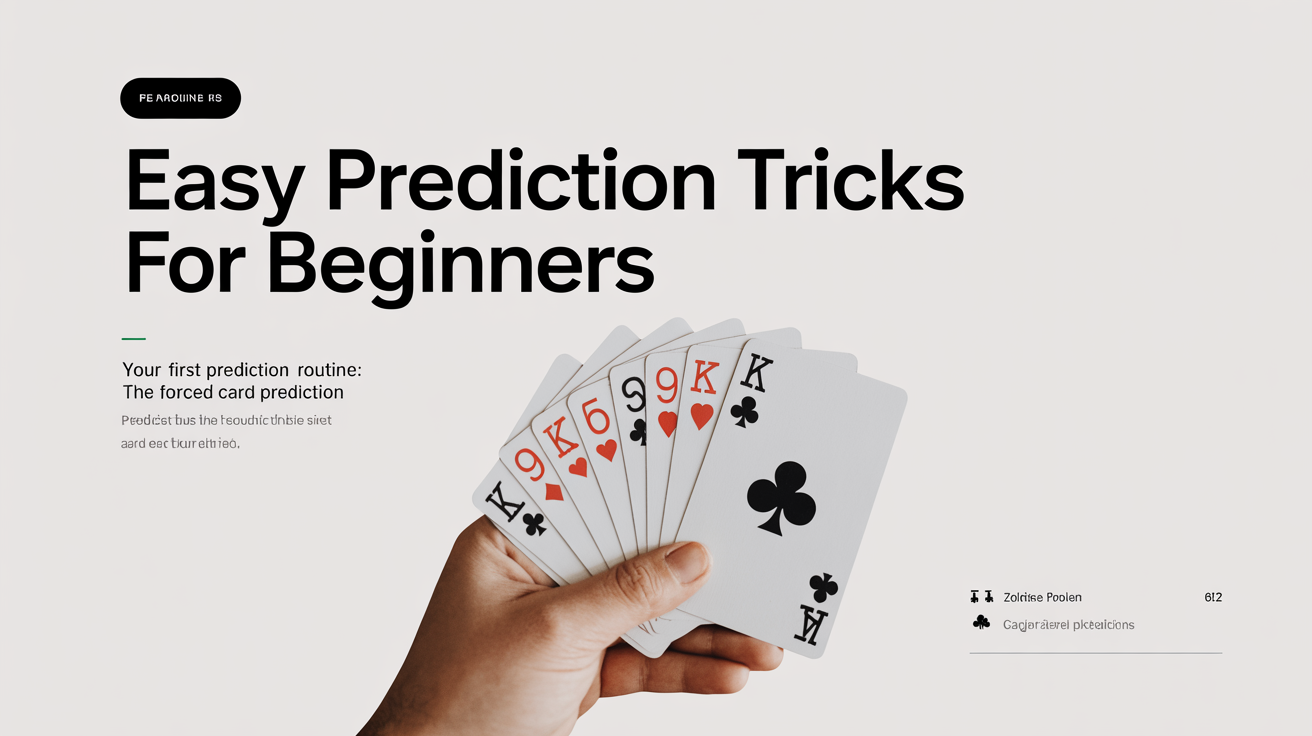
This is probably the most direct prediction trick a beginner can learn. The setup is clean, the method is invisible, and the reveal is genuinely striking.
You will need a standard deck of playing cards.
How to Set It Up
Before anyone arrives, decide on your prediction card. Let's say it's the Seven of Hearts. Write "Seven of Hearts" on a small card or slip of paper, seal it in an envelope, and set it on the table face down. You've done nothing suspicious yet.
Now arrange the deck so the Seven of Hearts sits in a position where a simple force will land on it. The specific force you use is up to you; card force methods vary widely in difficulty and style. A cut-force or a simple mathematical arrangement both work well here.
Performing the Routine
- Show the sealed envelope and hand it to a volunteer to hold. Don't make a big deal of it. "I wrote something down earlier. Hold onto that for me."
- Spread the deck face down and invite the spectator to "stop you anywhere" as you slowly push cards off the top. Use your force method to control their stop point to land on the Seven of Hearts.
- Have them remove the card without looking at it and hold it face down.
- Build the moment. Ask if they made a completely free choice. Ask if they could have stopped anywhere. They'll say yes.
- Have them turn their card over to reveal the Seven of Hearts.
- Ask the volunteer holding the envelope to open it and read what's inside.
The reveal hits hardest when there's a small pause between them seeing their card and them hearing you say "open the envelope." Let them sit with the impossibility for just a second.
Presentation Notes
Never repeat this trick for the same audience. Ever. The first time, it's astonishing. The second time, they're watching for the method and they'll find it. One clean performance and you walk away clean.
Your Second Prediction Routine: A Number Prediction
This routine uses a different principle entirely and requires nothing but a pen, paper, and some basic arithmetic. It's a strong beginner prediction trick because no cards are involved, and the method is mathematical rather than mechanical.
You will need two slips of paper, a pen, and a sealed envelope prepared in advance.
The Secret Setup
Before the routine, choose a target number. Let's use 1,089. Write "1,089" on a slip of paper, seal it in an envelope, and leave it somewhere visible but untouched.
The method is based on a mathematical property that secret math in magic covers in more detail. Here's the core: if a spectator picks any three-digit number where the first and last digits differ by at least two, reverses it, subtracts the smaller from the larger, then reverses that result and adds the two together, the answer is always 1,089. Every time. The math guarantees it.
A Worked Example
Walking through one full pass with real numbers makes the routine much easier to run smoothly, since you'll know exactly what a spectator's answer should look like at each step.
| Step | Action | Result |
|---|---|---|
| 1 | Spectator picks a three-digit number | 532 |
| 2 | Reverse the digits | 235 |
| 3 | Subtract the smaller from the larger | 532 minus 235 equals 297 |
| 4 | Reverse the result | 792 |
| 5 | Add the two together | 297 plus 792 equals 1,089 |
Try it again with a completely different starting number, say 916. Reversed, that's 619. Subtracted, 916 minus 619 is 297. Reverse that to 792, add the two, and you land on 1,089 again. Any qualifying starting number funnels into the same answer, which is exactly what makes the prediction bulletproof.
Performing the Routine
- Point to the sealed envelope on the table. "I made a prediction before we started. I want you to look at it at the end."
- Ask your spectator to think of any three-digit number where the first and last digits are different. "Make sure the hundreds digit and the units digit are not the same."
- Tell them to reverse those three digits to make a second number.
- Ask them to subtract the smaller number from the larger. (If the result has only two digits, treat it as a three-digit number with a leading zero, so 99 becomes 099.)
- Tell them to reverse those digits again and add that to the result.
- Ask them what they got.
- Pause, then have them open the envelope.
Handling the Reveal
The reveal lands best when you don't rush it. After they read out their final number, let a beat of silence pass. Then, calmly: "Open the envelope and read what I wrote." There's no need to explain or recap what just happened. The contrast does all the work.
If you're performing for a group, you can have several people do the calculation independently. They'll all arrive at 1,089, which makes it even stranger.
Practice Tips Before You Perform
A prediction trick depends on your composure more than anything else. You already know the outcome. The challenge is acting as though you don't.
- Run through the routine solo until every step feels automatic. You should never be thinking about what comes next while you're in front of an audience.
- Practice your "open face," the expression of genuine curiosity you wear while the spectator is making their choice. Looking too calm can give you away.
- Rehearse the number prediction's arithmetic prompts out loud so the wording ("subtract the smaller from the larger," "reverse the digits again") comes out smoothly instead of sounding like you're reading instructions.
- The moment you reveal the prediction, stop talking. Don't explain. Don't fill the silence. Let the effect breathe.
- Perform once per audience. A prediction seen twice is a puzzle to solve.
FAQ
Do prediction tricks require sleight of hand?
Most beginner-friendly prediction tricks don't. The routines in this article use mathematical forces and structural setups that work every time without any finger skill. As you advance, you might learn force techniques that involve subtle card handling, but you can build a strong prediction set with zero sleight of hand.
Can I use an app or calculator for the number prediction?
Yes, as long as it doesn't make the method obvious. Having the spectator use a calculator on their own phone is actually a nice touch, since it removes any suspicion that you're controlling the arithmetic. Just walk them through the steps verbally.
What if the spectator doesn't follow the instructions correctly?
For the number prediction, gently ask them to repeat the steps. If they made an arithmetic error, ask them to redo the subtraction or addition. Frame it as making sure the trick is fair, not as correcting a mistake. For card tricks, a force done correctly doesn't leave room for error on the spectator's part.
Is it okay to tell the audience I'm using a prediction?
Yes, and you should. The framing of "I made a prediction before we started" is part of what makes the effect work. Don't hide the structure. Let the audience know exactly what the standard is you're being held to. That's what makes the reveal so good.
Should I reveal how the trick works if someone asks?
Part of being a good performer is protecting the experience, for this audience and for future ones. A friendly "a magician never tells" is perfectly fine. You can also redirect with something like "the fun is in not knowing," and move on. Exposing the method doesn't impress people; a well-kept secret performed confidently does.
Why does the number prediction always land on 1,089?
It comes down to how three-digit subtraction and reversal interact with place value. Reversing a three-digit number and subtracting always produces a multiple of 99 (198, 297, 396, and so on, depending on how far apart the first and last digits are). Reversing and adding one of those multiples of 99 to itself always resolves to 1,089. You don't need to explain any of this to your audience; you only need to trust that the arithmetic never fails as long as the starting number qualifies.
What's a good backup if a spectator's number doesn't qualify?
If the first and last digits are the same (for example, 474), the subtraction produces zero and the trick collapses. If that happens, just say "let's make sure we get a real mix of digits" before they start, and give the one rule up front: first and last digits have to be different. Stated that plainly, spectators almost never pick a number that breaks the method.