How to Do a Clean Riffle Shuffle Without Dropping the Cards
Learn how to riffle shuffle cleanly with solid grip and hand position, fix the mistakes that make cards fly, and know when a false shuffle takes over.
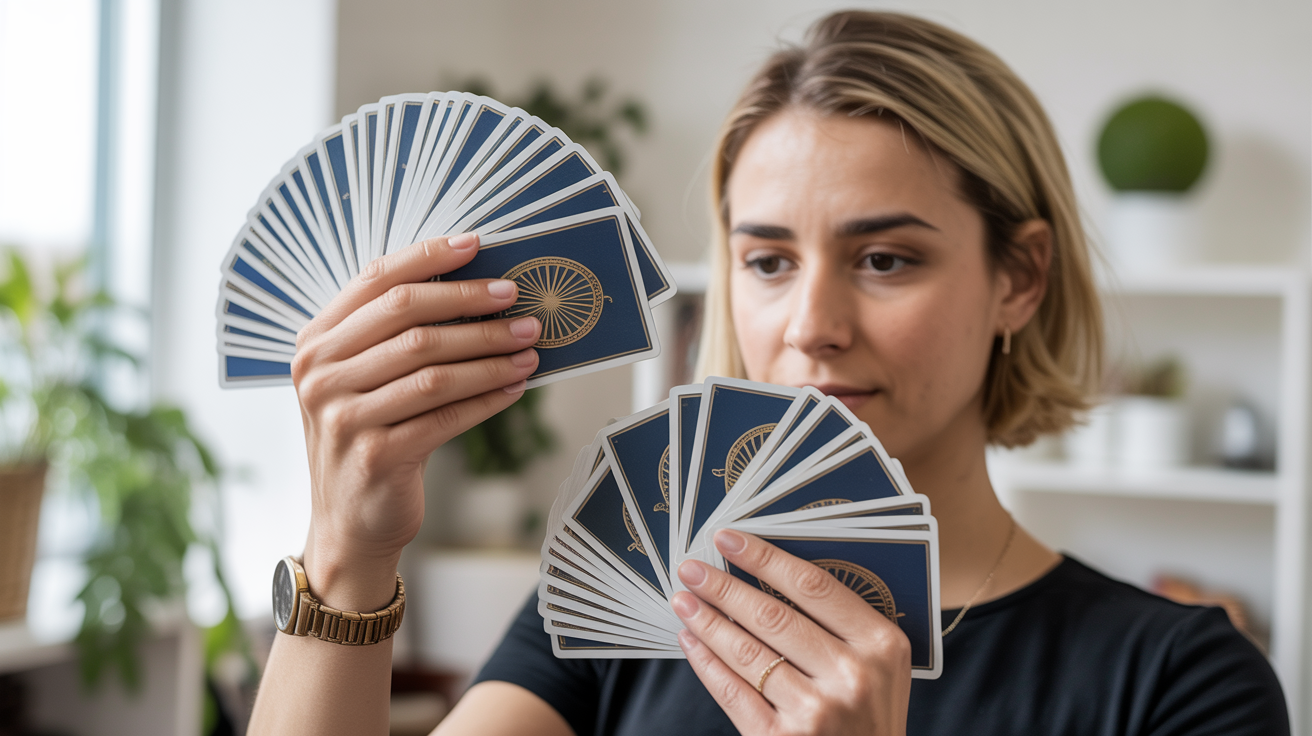
If you have ever watched a card trick fall flat before the magician even reached the secret part, the shuffle was probably the problem. Learning how to riffle shuffle cleanly, without cards spraying across the table or the deck buckling in your hands, is one of those unglamorous skills that quietly makes or breaks everything you do after it. A rough shuffle tells your audience you are still learning. A clean one tells them to relax and watch, because you clearly know what you are doing with a deck of cards. This guide covers the table riffle, the in-the-hands version, the mistakes almost every beginner makes, and why practicing on a cheap deck first will save your good one.
The Basics of How to Riffle Shuffle
A riffle shuffle works by splitting the deck into two roughly even halves, bending the inner corners of each half with your thumbs, and releasing the cards so they interlace, one from each half at a time, back into a single pile. Done well, it looks fast and confident and it actually mixes the cards. Done poorly, you get cards shooting off the table, corners bent at odd angles, or two piles that never quite merge and have to be jammed together by hand.
Magicians use the riffle shuffle constantly, not because it is flashy but because audiences expect it. It is the shuffle people picture when they picture someone handling cards well. Getting it smooth is worth the practice time on its own, apart from any trick you plan to build on top of it.
Splitting the Deck Into Two Even Halves
Before you riffle anything, you need two piles that are close to the same size. Hold the deck in one hand, then use the thumb of your other hand to lift up from roughly the middle and set that top portion down next to the bottom portion. Do not count cards. Feel for the middle by the thickness of the deck under your thumb. With practice your hands get accurate at this within a card or two, which is plenty close for a shuffle.
Set the two halves down (for a table riffle) or hold them side by side just above the table (for the in-the-hands version) with their inner short edges nearly touching, angled slightly toward each other like a shallow V.
The Table Riffle, Step by Step
The table riffle is the version most people picture first, and it is the easier one to learn because the table does some of the work for you.
- Place both halves on the table, long edges roughly parallel, with the inner corners close together and slightly overlapping.
- Rest your thumbs on the inner top corners of each half and curl your first two fingers around the outer edges to hold each pile steady. Your remaining fingers can rest lightly on the table for balance.
- Press down gently with your thumbs while lifting up just slightly, so each pile arches. Let the corners riffle off your thumbs slowly, a little at a time, rather than all at once.
- As the cards start to interlace, ease off the pressure and let the two halves settle into each other. Do not force them together at speed. Let gravity and the natural curve of the cards do the merging.
- Once the piles are combined, square the deck by tapping the edges gently against the table, or push the arched pile flat with your palms in one smooth motion (the classic "bridge and square" finish).
The table riffle rewards a light touch. Beginners almost always press too hard, too fast, which is exactly what causes the cards to jump.
The In-the-Hands Riffle
Once the table version feels natural, try it without a table, useful for standing performances or a kitchen counter that will not cooperate.
Hold each half in one hand, cards resting mostly on your ring and middle fingers, with your thumb on the inner corner and your index finger curled against the outer short edge for support. Bring the two inner corners together at a slight angle and riffle them off your thumbs exactly as you would on the table, just held a few inches in the air. The hand version needs a firmer grip on the outer edges, since there is no table to catch a card that slips, but the thumb action is identical to the table riffle.
Most people find the in-the-hands riffle harder at first because your hands are doing the stabilizing work that the table used to do for free. Give it more practice time than you think it needs.
Common Mistakes That Wreck a Beginner's Shuffle
Cards flying off the ends. This almost always means your thumbs are releasing too much pressure at once instead of letting cards go one or two at a time. Slow the riffle down and watch your thumbs rather than the deck.
Uneven piles. If one half is noticeably thicker, the interlace gets lopsided and the deck squares up crooked. Practice the initial split on its own, away from the shuffle, until your hands find the middle by feel.
A weak or nonexistent spring. New decks, especially cheap ones, can feel stiff and refuse to arch smoothly. This is partly the deck and partly your grip. Curl your fingers more around the outer edge to give the cards something to bow against.
Rushing because you are nervous. This is the one that actually costs you the audience. A shuffle that looks tentative or apologetic undercuts trust in everything that follows, long before you reach a method or a reveal. If you are still building your first routines, card tricks for beginners: where to start is a good next stop for sequencing your practice so the shuffle stops being the shaky part of the act.
Practice on a Beat-Up Deck Before You Touch Your Good One
Do not learn the riffle shuffle on the deck you plan to perform with. New or high-quality cards are stiffer and more expensive to wreck, and a beginner's grip puts real stress on corners and edges. Pick up a cheap, worn deck, or deliberately soften up an old one, and use it exclusively for shuffle practice until the motion feels automatic in your hands. Once the riffle is smooth and consistent, move to your performance deck and keep that one reserved for actual practice sessions and shows, not for grinding out repetitions. For more on picking decks and keeping them in shuffle-friendly shape, see how to choose and care for a deck of cards.
Working the shuffle in front of a mirror is also worth the time, since you can watch your own hand position instead of guessing at it from feel alone. The routine in how to practice sleight of hand in the mirror applies just as well to a clean riffle as it does to any sleight.
A Clean Shuffle Versus a False Shuffle
It is worth being precise here, because the two skills look similar but do very different jobs. The riffle shuffle covered in this guide is an honest shuffle. Cards genuinely interlace and the order of the deck actually changes. There is no method hidden inside it; it is exactly what it appears to be.
A false shuffle looks the same to an onlooker but is built to keep some or all of the deck in a known order, or to secretly hold certain cards in position, while still appearing to mix the deck fairly. False shuffles depend on first having a clean, convincing honest shuffle to imitate. If your real riffle looks awkward, a false version built on top of it will look even worse, because you are trying to fake confidence you have not built yet. Learn the honest shuffle first and get it comfortable in your hands before moving on to the false shuffle: keeping control while looking fair.
Frequently Asked Questions
How long does it take to learn a clean riffle shuffle?
It varies by person, but most beginners see steady improvement within the first few weeks of short, regular practice sessions. The table version usually comes together faster than the in-the-hands version, since the table helps with stability while you are still learning thumb pressure.
Why do my cards keep flying out of my hands?
This is almost always too much thumb pressure released too quickly, combined with fingers that are not curled firmly enough around the outer edges to contain the spring. Slow the whole motion down and focus on releasing cards a few at a time rather than all at once.
Do I need an expensive deck to learn on?
No, and you are better off learning on a cheap one. A worn, slightly softened deck is easier on your hands while you are figuring out grip and pressure, and it protects your good deck from the wear that comes with a beginner's mistakes.
Should I bridge and square the deck after every riffle?
It is not required, but it looks clean and gives the audience a natural pause between the shuffle and whatever comes next. Practice the bridge separately from the riffle itself so you are not trying to learn both motions at once.
Is a riffle shuffle actually random, or does it just look that way?
An honest riffle shuffle genuinely mixes the cards; it is not a trick or a method. How thoroughly a single shuffle randomizes the deck depends on how evenly the cards interlace, which is part of why performers often shuffle more than once. That is different from a false shuffle, which is built specifically to avoid randomizing at all while still looking convincing.