Spelling and Counting Card Tricks That Work Themselves
Learn how spelling and counting card tricks work, why they fool everyone, and how to perform them with confidence as a beginner.
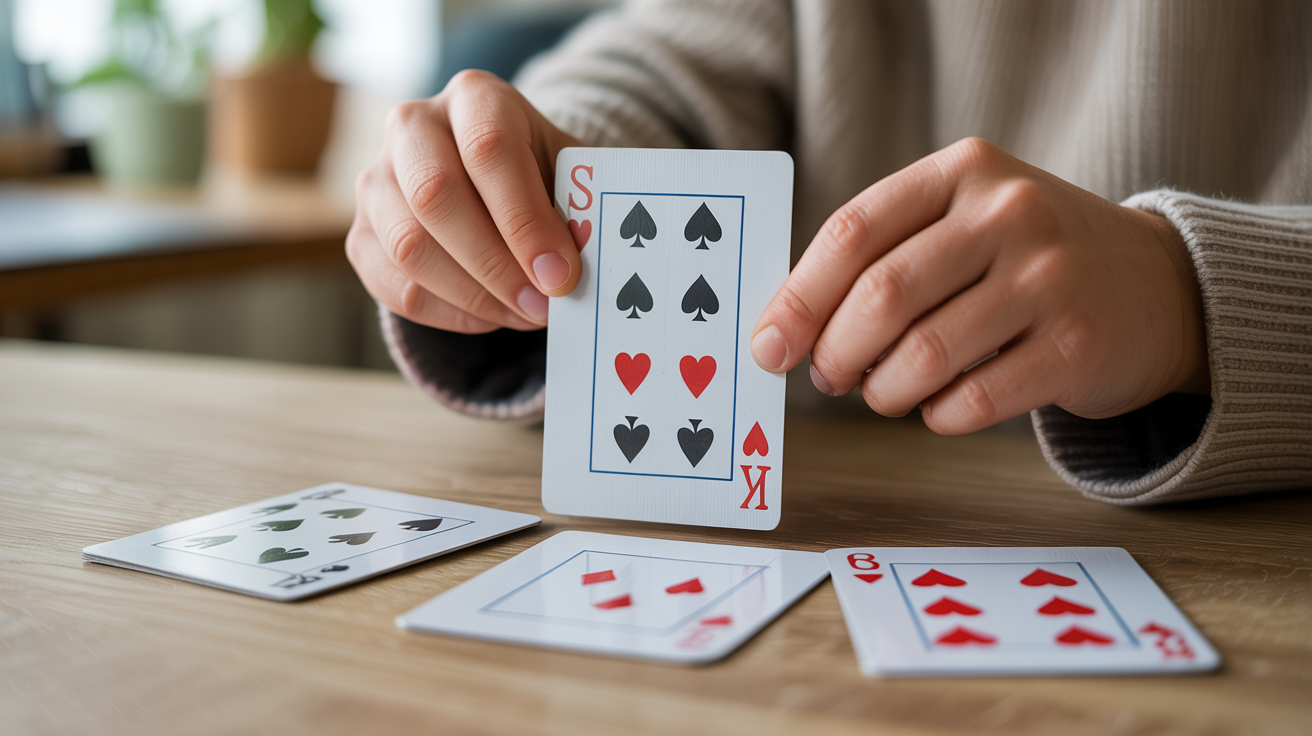
Some card tricks feel like puzzles the deck is solving on your behalf. Spelling and counting tricks belong in that category. You deal cards one at a time, spelling out a word or counting to a number, and the card that lands in your hand at the finish is exactly the one the spectator named. No palming, no forcing, no sleight of hand. The method is built into the structure of the deck itself.
That combination of simplicity and strong impact makes these tricks worth learning early. If you want to understand why they work so reliably, self-working tricks using secret math explains the underlying principle.
What Spelling Tricks Actually Do
A spelling card trick asks you to deal one card face-down onto the table for each letter in a word. Spell A-C-E, deal three cards. Spell K-I-N-G, deal four. The trick is designed so the card in your hand (or the next card you turn over) at the end of the spelling matches the selection.
The reason this works is positional. Before the trick starts, you know where the selected card sits in the deck, and you arrange it so the letter count of the word you will spell lands exactly on that position. The audience sees a casual deal. What they do not see is that the count has been set in advance.
For beginners, this is good news. Once you understand the setup, the performance takes care of itself. Your hands are never in a suspicious position because they do not need to be.
A Basic Deal-and-Spell Trick You Can Do Tonight
This version works with a standard 52-card deck and no preparation beyond a simple card control.
The setup. Have a spectator choose a card, look at it, and return it to the top of the deck. Give the deck one straight cut. The selected card is now somewhere near the middle, but you do not know exactly where.
Here is the handling that removes the guesswork: before the cut, secretly note the number of cards above where the selection will land after the cut. A simple way to do this is to hold a small break with your thumb as the spectator replaces the card, count or estimate the cards below the break as you cut, and keep that number in mind.
The spelling. Ask the spectator to name their card out loud, for example, the Seven of Clubs. Spell out S-E-V-E-N O-F C-L-U-B-S, dealing one card face-down for each letter. Turn over the next card. It is their selection.
The letter counts for most card names fall between 13 and 15, which is why the trick is set up around that zone. You are not doing arithmetic in your head during the performance; you did the positioning work before spelling began.
If the letter count does not line up perfectly on your first attempt to learn this, practice with a face-up deck so you can see exactly where the card lands and adjust your control accordingly.
Counting Tricks and How They Differ
A counting card trick uses numbers instead of letters, but the logic is the same. You count down from a chosen number, deal that many cards, and reveal the selection at the end.
One common version asks the spectator to think of any number between 1 and 10, then quietly count that many cards off the top into their hand, peek at the bottom card of that packet, and replace the packet. You then take the deck and count to their number, landing on their card.
The handling here involves a straightforward deck switch move that brings the chosen position to the correct spot. It is the kind of thing that sounds technical but takes about five minutes to learn with cards in hand.
Counting tricks tend to read differently from spelling tricks in performance. Spelling has a theatrical quality because the audience hears a word being spelled aloud. Counting feels more mathematical, which suits some audiences and some performers better. Having both in your repertoire gives you options. For context on how these fit into a broader set of self-working magic tricks, that overview is a useful starting point.
How to Present These Tricks Effectively
The mechanics are the easy part. Presentation is what turns a card trick into a moment.
A few things that help with spelling and counting tricks specifically:
Let the spectator do some of the dealing. When the audience handles the cards, the idea of a hidden setup becomes harder to imagine. If the method allows it (and with some spelling tricks it does), hand the deck to the spectator and have them deal while you call out the letters.
Slow down at the end. The payoff comes on the final card. Rushing through it wastes the effect. Pause after dealing the last card. Let a beat of silence build before the reveal.
Do not announce what is about to happen. Instead of saying "your card will appear when I finish spelling," just spell and let it happen. The surprise lands harder when the audience does not know to expect it.
React with them, not ahead of them. When the card appears, give it a moment before you say anything. Letting the audience register the effect before you comment makes the reaction feel genuine.
Practical Table: Common Card Names and Letter Counts
Different card names produce different counts, which affects how you set up each trick. Here is a reference for the most common ones.
| Card | Spelled Name | Letter Count |
|---|---|---|
| Ace of Spades | ACE OF SPADES | 11 |
| Two of Hearts | TWO OF HEARTS | 12 |
| Five of Clubs | FIVE OF CLUBS | 11 |
| Seven of Clubs | SEVEN OF CLUBS | 13 |
| Eight of Diamonds | EIGHT OF DIAMONDS | 15 |
| Queen of Hearts | QUEEN OF HEARTS | 14 |
| King of Spades | KING OF SPADES | 13 |
| Jack of Diamonds | JACK OF DIAMONDS | 14 |
When you are learning, start with cards whose names produce counts in the 12 to 14 range. Those positions are easiest to set up reliably with a simple card control.
Frequently Asked Questions
Do I need a special deck for spelling card tricks?
No. A standard 52-card deck works for all of the tricks described here. There are commercial spelling decks sold in magic shops, but they are not necessary for beginner-level effects. Once you understand the method, you can perform with any borrowed deck.
What if a spectator names a card with a short name like Ace of Clubs?
Short names produce smaller counts, which means the card needs to sit closer to the top of the deck. This is manageable once you are comfortable with your card control. Some performers solve this by limiting the selection to cards above a certain count, though doing so narrows the trick.
Can I do a spelling trick without controlling the card first?
Yes, with a pre-arranged deck. Some self-working spelling tricks use a specific card order that makes any selection spell to the right position automatically. These are worth exploring once you are comfortable with simpler versions. Easy prediction tricks for beginners covers related setups you may find useful.
How many times can I perform the same spelling trick for the same audience?
Once, ideally. Repeat performances invite inspection of the method. If someone asks to see it again, do a different trick with a similar impact rather than repeating the same one.
Is it okay to tell the audience I am spelling out the card's name?
Yes, announcing the spelling is part of the presentation. The audience can follow along and still not understand how the trick works, because they do not know where the selected card is sitting in the deck. Transparency about what you are doing (spelling) is different from transparency about why it works (the positional setup).