How to Control a Card to the Top of the Deck
Learn how to control a card to the top of the deck using the overhand shuffle injog, a beginner-friendly technique with clear step-by-step guidance.
A spectator picks a card, loses it somewhere in the deck, and you produce it from the top a moment later. That moment is one of the most satisfying things in card magic. The method that makes it possible is called a card control: a sleight that secretly moves a chosen card to a position of your choosing while appearing to mix the deck fairly.
This guide covers the overhand shuffle injog control, a practical technique that looks like a casual shuffle and puts the selection right where you need it. If you are new to card handling, this is a reasonable place to start building your sleight-of-hand vocabulary.
At a Glance
- A card control secretly moves a chosen card to a known position, usually the top, while the shuffle still looks completely fair.
- The overhand shuffle injog control uses two moves: an injog (a card pushed out slightly) planted during the return, then a strip that carries everything above it to the bottom.
- Most people get the mechanics correct in one session; looking natural under real pressure takes a few days of casual practice.
- The injog only needs to protrude a quarter to half an inch. Bigger than that creates a visible bump and gives the method away.
- A spectator cutting the deck after your control will move the card off the top, so go straight into your reveal, or add a false cut later.
- Works with any standard deck; broken-in cards are easier to learn on than a stiff new deck.
What Is a Card Control and Why Does It Matter
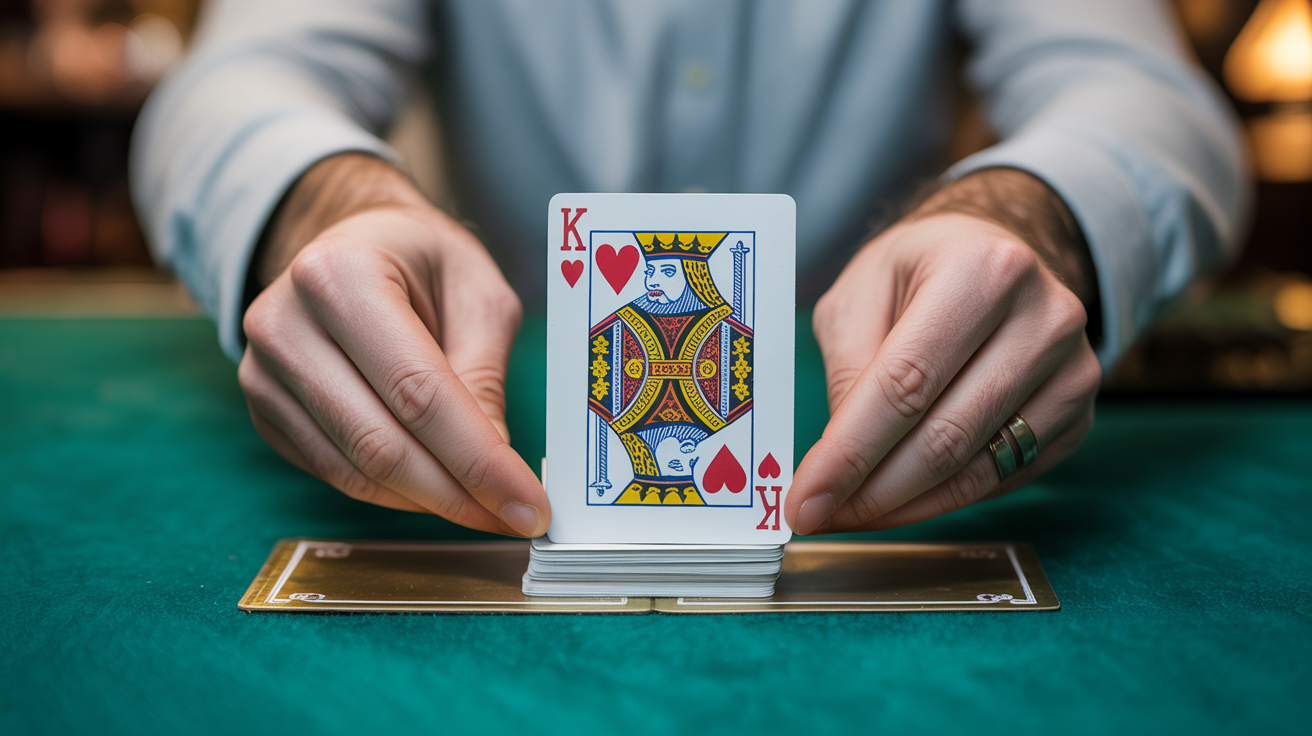
A card control is any technique that secretly maneuvers a specific card from one position in the deck to another. The most common goal is to bring the selection to the top, where it becomes easy to reveal in a variety of ways. Card manipulation as a discipline, what most people just call card magic, covers exactly this kind of technique: sleight-of-hand moves built to be undetectable while secretly repositioning cards during a performance.
Knowing how to control a card opens up a large category of tricks. Many routines begin with a selection and end with a reveal at the top. Once you can consistently control a card there, you have a foundation that dozens of effects can be built on.
The overhand shuffle control is a good starting point because the overhand shuffle is already a familiar, everyday action. Most people riffle-shuffle in private but overhand-shuffle in public because it looks more casual. That familiarity works in your favor: spectators already expect to see it and are not watching too closely.
How the Overhand Shuffle Injog Control Works
The method has two parts: marking the position of the selection during the return, then using a shuffle sequence to secretly bring it to the top. The base action, an overhand shuffle, is simply the technique of transferring the deck from one hand to the other by sliding off small packets from the top with your thumb, over and over, until the whole deck has moved across. The injog control hides its secret work inside that ordinary, repetitive motion.
Returning the card. After the spectator takes a card, split the deck roughly in half and hold the bottom half in your left hand, faces down, packet angled slightly toward you. Ask the spectator to place the card on top of that bottom half. As they do, push the top card of the lower packet outward toward yourself about half an inch with your left thumb. This protruding card is called the injog. The selection sits directly below it, though no one else can see the injog unless they are standing behind you.
Place the upper half of the deck on top of everything. The deck looks squared and the selection appears lost.
Executing the shuffle. Hold the deck in the right hand for an overhand shuffle. Begin shuffling by stripping small packets from the top into the left hand, just as you normally would. When your right thumb feels the injog card stick out slightly, it acts as a natural break. At that point, use your right thumb to pull all the cards above the injog as one block and drop them under the left-hand packet. What you have done is strip all the cards that were above the selection and move them to the bottom. The selected card is now sitting on top.
To a spectator watching a casual shuffle, this looks like you simply continued mixing. Done smoothly, there is nothing suspicious to see.
Step-by-Step Practice Sequence
Breaking the technique into small pieces makes it easier to learn without frustration.
-
Practice the injog alone. Take the bottom half of a deck, hold it face-down in your left hand, and practice pushing the top card inward with your thumb until it feels natural and automatic. Do this ten or twenty times before adding anything else.
-
Practice the return. Ask a practice spectator (or use a chair as a stand-in) to return a card on top of the lower half while you subtly apply the injog. The goal is to do it without looking down and without hesitating.
-
Practice locating the break. Square the full deck and hold it in shuffle position. Run your right thumb along the side of the deck and find the protruding injog card. At first, look directly at it. Once you can find it by feel, practice without looking.
-
Combine the shuffle. Start the overhand shuffle, pull all cards above the break as a block, and drop them under the left-hand packet. Check the top card to confirm the selection arrived there.
-
Run it continuously. Do the whole sequence from the return through the shuffle without stopping. Aim for smooth pacing; a hesitation during the shuffle is more suspicious than a slightly imperfect injog.
A common reference point for practice: if the top card surprises you half the time, you are getting closer. If it is consistently the selection after a few sessions, the control is working. Most beginners hit that consistent mark somewhere between their third and tenth full run-through; if you are still missing more than half the time by run twenty, slow down and isolate whichever of the five steps above keeps breaking.
Common Mistakes and How to Fix Them
The injog is too obvious. The card only needs to protrude a quarter to half an inch. A larger injog creates a visible bump in the deck. Work on using lighter pressure and less movement from the thumb.
The shuffle pauses at the break. This draws attention to exactly the moment you want to hide. Practice separating the two actions mentally: find the break while still shuffling, then complete the strip at a normal pace without slowing down.
The wrong cards end up on top. If you are dropping the block under and the selection is not appearing on top, check which direction you are pulling the break block. The cards above the injog come off and go below. The selection should then be sitting on top of the remaining packet.
Looking down during the injog. This is the surest way to tip a spectator that something is happening. Maintain eye contact or look at the spectator while they return the card. Let your hands do the work without visual confirmation.
Using the Control Inside a Trick
The control is a means to an end. Once the card is on top, you need a reveal. A few simple options that work well for beginners:
- Snap reveal. Snap your fingers over the deck and flip the top card face up.
- Turnover. Ask the spectator to name their card, then turn over the top card to show it.
- Dealing deal. Deal the top card face-down onto the table, build a little moment, then flip it over.
You can also stack additional controls: perform one more overhand shuffle after the control, leaving the top card in place, to make the mixing look even more convincing. As long as you do not shuffle the top card away, you can shuffle as many additional times as you like.
For more foundational card work, card tricks for beginners covers where to start if you want the bigger picture. And once you have the control down, learning how to use a key card adds a second approach to locating selections that pairs well with this one. If you want to take things further, a simple card force lets you guide the spectator's choice before they even pick a card.
Comparing Your Next Control Options
Once the overhand injog control feels solid, several related techniques extend what you can do with a controlled card. Here is how they stack up against each other.
| Technique | What it does | Difficulty after this one | When to reach for it |
|---|---|---|---|
| Overhand injog control (this guide) | Brings a selection to the top during a casual shuffle | You just learned it | Everyday, casual performing situations |
| Key card | Locates a selection without controlling it to the top at all | Similar difficulty, different skill | Tricks where the card needs to stay lost in the deck until the reveal |
| False cut | Preserves a controlled top card through an apparent cut | Slightly harder, needs its own practice | Whenever a spectator might ask to cut the deck after your control |
| Riffle shuffle control | Controls a card during a riffle shuffle instead of an overhand shuffle | Noticeably harder | Close-up settings with attentive spectators who expect a riffle shuffle |
Frequently Asked Questions
How long does it take to get comfortable with the injog control?
Most people can get the mechanics right in a single session. Looking natural takes a bit longer, maybe a few days of casual practice. The shuffle portion tends to click faster than the injog application during the return, so start there if you feel stuck.
Do I need a specific deck to learn card controls?
No. Any standard poker-size deck works fine. Older, broken-in cards are actually easier to work with when you are learning, because they slide more predictably than a fresh, stiff deck.
Is the overhand shuffle control "good enough" for performance?
Yes, for most casual settings. It is used by working magicians all the time. If you eventually want something more deceptive for close-up settings where spectators are very attentive, you can explore other controls later. But this one will take you far.
What if a spectator wants to cut the deck after I control the card?
A cut after the control will move the selection away from the top. The simplest fix is to perform the control and then immediately go into the reveal, before offering a cut. Alternatively, you can learn a false cut to add later, but that is a separate skill.
Can I use this control with the riffle shuffle instead?
There are overhand controls and riffle-shuffle controls, and they work differently. The injog method described here is specific to the overhand shuffle. The riffle shuffle has its own set of controls, which are worth learning eventually, but start with one approach and get it solid before adding another.
How many overhand shuffles can I do before or after the control without losing the card?
As many as you like before the control, since that just mixes a deck you have not marked yet. After the control, you can add more overhand shuffles too, as long as each one strips from the top down without ever including the top card itself in a stripped-off packet. When in doubt, practice the "one more shuffle" version separately so you know exactly what it looks like before adding it into a live performance.