How to Do a Simple Card Force
Learn how to force a card with three beginner-friendly methods, including the cross-cut force, countdown deal, and equivoque — all explained step by step.
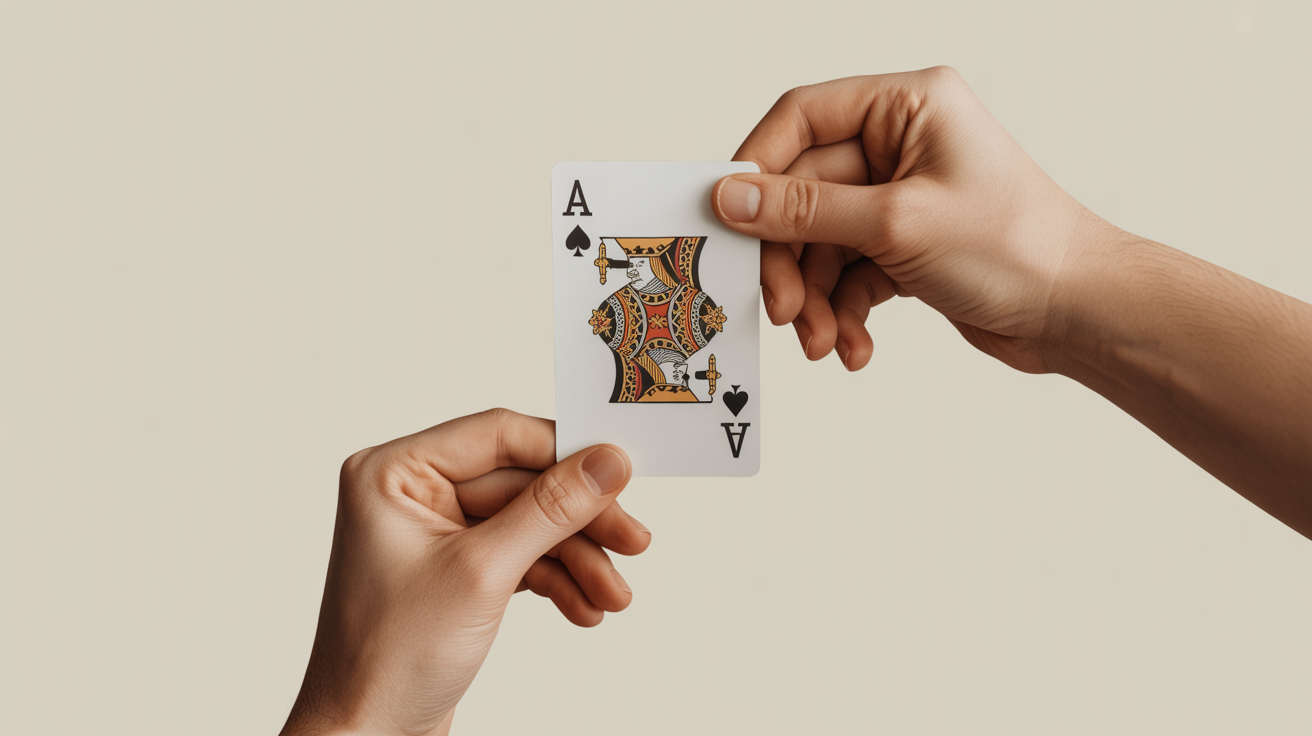
A card force is the sleight-of-hand secret that makes many classic card tricks possible. You control which card a spectator "chooses," but to them, the choice feels completely free. Because you already know the card before they pick it, any prediction you make lands perfectly, every time.
Most people assume card magic depends on superhuman dexterity. The forces covered here prove otherwise. They rely on timing, a little conversation, and an understanding of how attention works. Anyone can build those skills with a week of practice.
What a Force Is (and Why It Works So Well)
A force is a technique that steers a spectator toward a specific card while preserving the appearance of free choice. The spectator genuinely believes they picked at random. You know the outcome in advance.
This matters because it completely changes your relationship to the trick. Instead of hoping the spectator picks the right card, you have certainty. That certainty frees you to focus on presentation and timing rather than nervous mental arithmetic.
Forces are not mind control. They work because people are not paying attention to the same things you are. Your spectator is watching the deck, the drama, the moment of reveal. They are not tracking which card was at which position thirty seconds ago. You exploit that gap.
The Magician's Code and Forces
Because forces involve guiding a choice without the spectator knowing, they sit at the heart of what makes magic feel like magic. Respect that. Practice privately, and do not repeat a trick for the same audience once they have seen it. The principle behind a force is something to protect, not explain.
The Cross-Cut Force
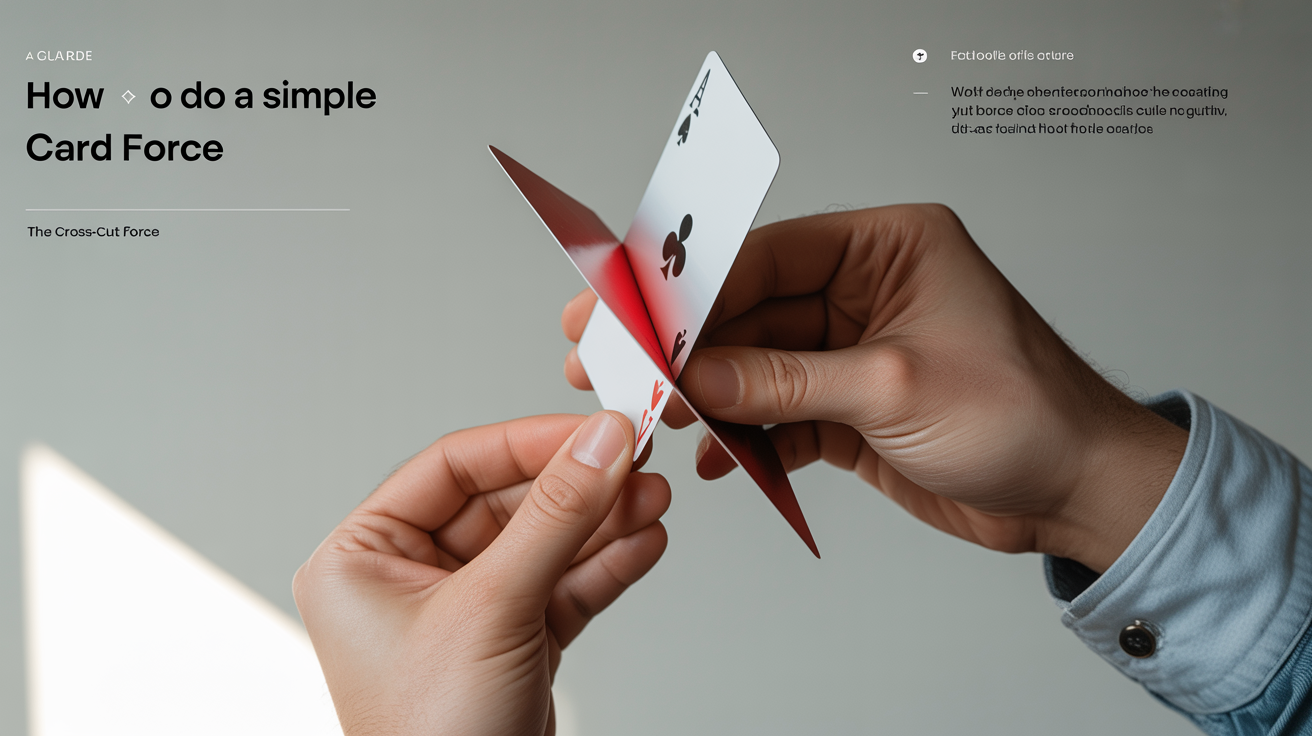
This is the most reliable force available to a beginner. It requires no sleight of hand, only misdirection and a small beat of time. Audiences consistently find it convincing.
How to Set It Up
Before the trick begins, you need to know the top card of the deck. Peek at it casually while squaring the cards, or secretly note it during a previous handling. Remember that card. That is the card your spectator will "choose."
The Steps
- Place the deck face-down on the table.
- Ask your spectator to cut the deck anywhere they like, lifting off the top half and setting it aside.
- Pick up the bottom half and lay it crosswise on top of the portion they cut off. This forms a cross shape on the table.
- Here is the critical step: talk. Recap what just happened. "You cut the deck freely, right? Wherever you wanted." Let five to ten seconds pass while you chat. This pause is the entire trick.
- Lift off the top (crosswise) packet and gesture to the face-up card now showing on the lower portion, saying, "Let's see where you cut."
The card they see is the original top card of the deck, the one you knew from the start. They believe this is the card that was at the position they cut to. In reality, the crosswise placement was a marker that got overwritten in their memory during the pause. They remember cutting; they do not remember which half you placed where.
What Makes the Pause Work
Human memory for recent visual details is surprisingly short. After several seconds of conversation, the spectator has already lost the precise mental image of how the packets were arranged. The cross pattern feels like a neutral marker, not a swap. That reframing happens automatically, in their mind, without any help from you.
Common Mistakes
- Moving too fast. Lifting the crosswise packet immediately after placing it collapses the time misdirection before it can work. Let the moment breathe.
- Staying silent during the pause. An awkward silence draws attention. Fill it with something natural: "You could have cut higher or lower, it was entirely your call."
- Peeking at the cross when you lift it. Look at your spectator, not the deck. Confidence in your gaze sells the moment.
The Countdown Force
This method uses dealing and counting to deliver a chosen card, and it is almost entirely self-working. It suits situations where you want the spectator to feel even more in control of the process.
The Steps
- Note or secretly control the card you want to force to the top of the deck.
- Ask the spectator to name any number between, say, five and fifteen.
- Deal cards one at a time face-down onto the table, counting aloud as you go.
- When you reach their number, pause and turn over that card.
The catch: you deal the cards by picking them off the top and placing them in a pile. The first card dealt becomes the bottom of the new pile. When you deal down to their number, the top card of the original deck (your force card) will land at... well, not exactly at their number, which is why there is a small adjustment to make.
Making the Count Work
The reversal of order during dealing means your force card ends up at position one in the new pile, which is the last card you would reach. To hit a specific number reliably, you need to know it in advance.
A cleaner approach for beginners: before the spectator names a number, you deal the cards and note how many you deal before offering to stop. This is closer to equivoque (explained below) than pure countdown. If they say "five," you stop at five. If they say "twelve," you deal to twelve. In both cases, you have already placed your force card at whichever position you quietly counted to before asking them to stop you.
This takes a moment to get comfortable with, but it removes all calculation from the performance.
A Simple Equivoque (Magician's Choice)
Equivoque, also called the magician's choice, is a verbal technique rather than a physical one. You offer apparent choices, but every option leads to the same result. For forcing a single card, a simplified version works well.
The Steps
- Place four cards face-down on the table, one of which is your force card. Note its position.
- Ask the spectator to point to two cards.
- If they point to your force card and one other, set aside the other card and keep the two they chose. Say, "We'll work with these two."
- Now ask them to point to one of the remaining two.
- If they point to your force card, turn it over: "That's your card."
- If they point to the other card, set it aside: "That one's out." Then turn over your force card as "the last remaining."
The spectator made two choices and ended with your card regardless. They experience it as free selection.
Keeping It Natural
The phrasing shift between steps 3 and 4 is the hinge. When they pick two cards that include yours, you "keep" what they chose. When they pick two that exclude yours, you "eliminate" what they chose. The word "eliminate" versus "keep" flips based on whether your force card is in the group. Practice saying both versions until they sound identical in tone and pace. That consistency is what prevents the audience from noticing the swap in logic.
Putting Forces Into Your Tricks
A force only matters when it connects to an outcome. Before performing any force, decide what you will reveal. Common setups include:
- A prediction card sealed in an envelope before the trick begins
- A number written on a piece of paper ("I knew you'd pick that card")
- A matching card already placed somewhere visible in the room
Once you can reliably deliver your force card, the presentation is what separates a good trick from a great one. Slow down at the reveal. Let the spectator understand what they are seeing before you explain it.
To build the supporting skills, the article on card tricks for beginners covers the fundamentals of handling a deck naturally. For a single principle that pairs well with forces, the key card method shows you how to track a selected card without any force at all, a good complement when you want to vary your approach.
Practice Notes
Learn one force at a time. The cross-cut force is the natural starting point because the mechanics are the simplest: you place one packet on another and wait. Run through it in front of a mirror until the pause feels natural rather than planned. Only then move to the countdown or equivoque.
Record yourself occasionally. Watching a playback often reveals that the "suspicious pause" you felt during practice is invisible on camera. The mind of the performer magnifies tiny moments that audiences never notice.
Perform for one person before trying a group. A single, relaxed spectator gives you honest feedback without the pressure of a crowd.
FAQ
Is the cross-cut force actually foolproof?
No force is technically foolproof, but the cross-cut is exceptionally reliable when the timing is right. The main failure mode is lifting the crosswise packet too quickly, before the misdirection has had time to settle. With five to ten seconds of natural conversation between the cut and the reveal, the great majority of audiences will be fully convinced.
What if my spectator catches on to equivoque?
This is rare with a simple two-stage version, but it can happen with attentive audiences. If someone notices the pattern, acknowledge it with a smile and move on. Do not repeat the technique in the same performance. Equivoque works best when you vary the phrasing naturally and keep the total number of selections small.
Do I need a special deck?
None of the forces here require anything beyond a standard deck of playing cards. No gimmicks, no marked cards, no trick decks. That is part of what makes them useful starting points.
How do I know which card to force?
Pick a card that matches your planned reveal. If you have written a prediction before the trick, you force the card you wrote. If you are using a matching card hidden in a book or under a glass, you force the card that matches it. The force is planned around the effect, not the other way around.
Can I use these forces in a longer routine?
Yes, and that is where they become most powerful. A force fits naturally into any routine that ends in a "revelation" moment. String two or three effects together and use a force in the middle; the surrounding tricks provide context that makes the climax land harder. Once you are comfortable with the double lift, you will find it pairs naturally with forces to extend what you can accomplish with a single deck.