The Double Lift: A Foundational Card Move
Learn how to do a double lift card trick step by step. Master the pinky break, the lift, and the replace — the building blocks of dozens of card effects.
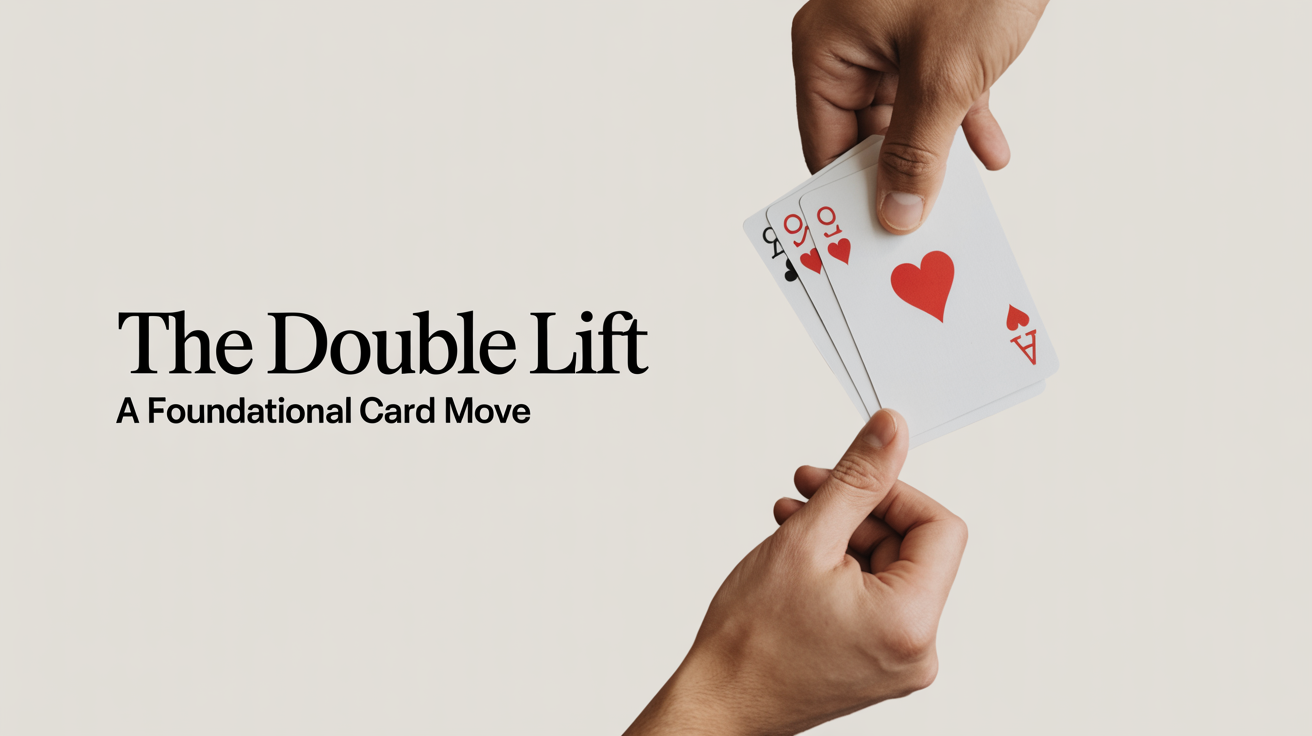
The double lift is probably the single most important move you will learn as a card magician. It looks like you are flipping over the top card to show the audience, but you are secretly lifting and displaying two cards as though they were one. That tiny deception is the engine behind dozens of card tricks, effects where a card visually changes, jumps, or behaves impossibly. If you put in the practice time to make this move natural, a huge range of magic opens up to you.
What the Double Lift Actually Does
When you flip the top card face-up during a trick, everyone assumes they are looking at a single card. In a double lift, they are actually looking at two cards held perfectly together. The audience sees the face of the second card from the top while believing it is the top card. You then flip them back down as a unit, and now the actual top card is one the audience has never seen.
That gap between what the audience believes and what is actually true is the foundation of the effect. A spectator picks a card, you control it to second from the top, and then with a double lift, you show them what looks like a different card entirely. When you peel off the true top card a moment later, their selected card has "appeared" in your hand.
This is why magicians call it foundational. It is not a trick on its own so much as a tool that makes other tricks work. If you want to explore those downstream effects, the guide on card tricks for beginners, where to start covers several routines that rely on exactly this move.
Getting Your Break: The Setup Before the Lift
Before you can lift two cards as one, you need to secretly separate them from the rest of the deck. This preparation is called getting a break, and it happens at the inner edge of the pack (the edge closest to you as you hold the cards).
The Pinky Break Method
Hold the deck in your left hand in a standard dealing grip: four fingers curled along the front edge, thumb along the left side. Your left pinky sits at the inner right corner of the deck.
To get the break:
- With your right hand, lightly riffle the inner right corner of the deck with your right thumb, releasing cards one at a time from the bottom of the deck upward.
- Stop the riffle after you have released exactly two cards. Your left pinky tip now sits in the gap between the second card from the top and the rest of the deck.
- Hold that gap open with your pinky. It only needs to be a millimeter or two, barely visible from the front.
That gap is your break. It tells your fingers exactly where the two top cards end and the rest of the deck begins.
The Push-off Method
Some beginners find the push-off easier to start with. Using your left thumb, push the top card slightly to the right. Then push the second card along with it so both slide together as a unit. Your right fingers contact the outer right edge of both cards together. You can then lift from there.
The push-off is faster to learn but slightly more visible if your hands are not relaxed. The pinky break takes a bit more coordination to set up, but the actual lift looks cleaner once you have it. Try both and see which feels more natural after a week of practice.
Performing the Lift
Once you have your break, the lift itself has three parts: the pickup, the display, and the replacement.
Step-by-Step Lift
- Move your right hand over the deck. Your right thumb contacts the inner edge of the two cards above the break, and your right middle finger contacts the outer edge. Your index finger rests lightly on top.
- Lift both cards as a unit. They should come up together without any spreading or buckling. The key is to pick them up from both ends simultaneously so they stay perfectly flat against each other.
- Display the face. Turn the double card over and rest it face-up on the deck, or hold it up toward the audience for a moment. Either way, handle it with exactly the same casual confidence you would use for a single card.
- Replace and flip back down. Flip the double card face-down onto the deck the same way you turned it up, maintaining the two-card unit throughout.
After the double is back on top face-down, the true top card is now one the audience has no knowledge of. Whatever you showed them is secretly second from the top.
The Keys to Making It Invisible
The mechanics are only half the battle. Plenty of beginners can pick up two cards cleanly but still flash the move because of what they do around it.
Keep Them Perfectly Squared
Any gap between the two cards will catch the light and reveal the second card's edge. Before you lift, take a half-second to press the top of the deck lightly with your right hand, squaring everything together. The two cards should be as flush as a single card when you pick them up.
Handle It Like a Single Card
This is the bigger issue for most beginners. When people know they are holding two cards, they tend to grip them more carefully, move more slowly, and avoid letting the edges face the audience. All of that signals to a watching eye that something is off. Practice handling the double until it feels unremarkable to you, because only then will it look unremarkable to someone else.
Do Not Emphasize the Moment
The lift should not be a performance beat. You are not "dramatically revealing" the card; you are just casually showing it as part of the flow. The audience's attention should be on the face of the card you are displaying, not on the motion of your hand.
Common Mistakes and How to Fix Them
The cards spread or fan apart. This almost always means you are lifting from one end only, or your grip is uneven. Focus on contacting both the inner and outer edges at the same moment.
The lift looks deliberate and slow. Usually this is hesitation from nerves or from not trusting the grip. Slow, careful lifts are more suspicious than quick, confident ones. Drill the pickup motion by itself until it feels automatic.
You lose the break before you can lift. The break only needs to last a second or two. If your pinky keeps slipping out, try getting the break slightly deeper, but not so deep that it distorts the deck.
You avoid showing the edges to the audience. This is a tell. If you consistently angle the cards away from certain sightlines, people sense something is being hidden even if they cannot name why. Work on lifting in a way that lets you display the card naturally in any direction.
A good practice drill: sit alone with a deck and do fifty double lifts in a row while watching your hands in a mirror or your front-facing camera. You will spot any inconsistencies quickly, and repetition builds the muscle memory that makes the move feel automatic.
A Simple Effect Using the Double Lift
Here is a clean, beginner-friendly routine that puts the move to work.
Have a spectator choose a card, look at it, and hand it back to you. Control it to second from the top using any method you know, a simple overhand shuffle control works fine. (If you want to explore other ways to position a chosen card, the key card principle is another excellent option to learn alongside this.)
Now hold the deck face-down and tell the spectator you are going to show them a card that is definitely not theirs. Perform the double lift, showing the face of the second card. Make sure they see and register it. Flip the double back down.
Here is where the simple card force and related control techniques start to connect, the stronger your overall card handling, the more convincingly you can lead into this moment.
Deal the actual top card face-down onto the table without showing it. Tell the spectator that card is going to travel invisibly across the deck and transform. Ask them to name their chosen card. Turn over the card on the table. It is their card.
That is the whole trick. It relies entirely on the double lift, and when the move is clean, the effect is genuinely strong.
FAQ
How long does it take to learn the double lift?
Most beginners can get a passable double lift within a week of daily practice, maybe twenty minutes a day. A truly invisible one that holds up under close conditions takes longer, sometimes a few months of regular use in real performances. Do not rush to perform it until you can do it without thinking.
Do I need a special deck?
No. A standard poker-size deck works well. Many magicians find that a slightly broken-in deck is easier to handle than a brand new one because the cards slide more smoothly against each other. Avoid very slippery casino-grade cards when you are just starting out.
Is the double lift considered a secret I should not share?
The double lift is a well-known fundamental technique that has appeared in countless published books and instructional resources for decades. Teaching it in an educational context is standard in the magic community. That said, performing magic means letting people experience the wonder of not knowing, so while you are learning, practice in private and be thoughtful about who you explain the mechanics to.
What should I learn before the double lift?
Get comfortable with a basic overhand shuffle and with holding the deck in a clean dealing grip first. If you can handle the cards without looking at your hands, you are ready to work on the double lift.
How do I know when my double lift is good enough to perform?
Perform it for a camera with nobody watching. If you cannot see the second card's edge and the handling looks like a single card, it is good enough to try with a live audience. Start with people who are supportive and not actively trying to catch you out, the early performances will teach you more than any amount of solo practice.