The False Cut: Keep the Deck in Order Secretly
Learn how to do a false cut that looks exactly like a real shuffle but leaves the deck untouched. Step-by-step guide for complete beginners.
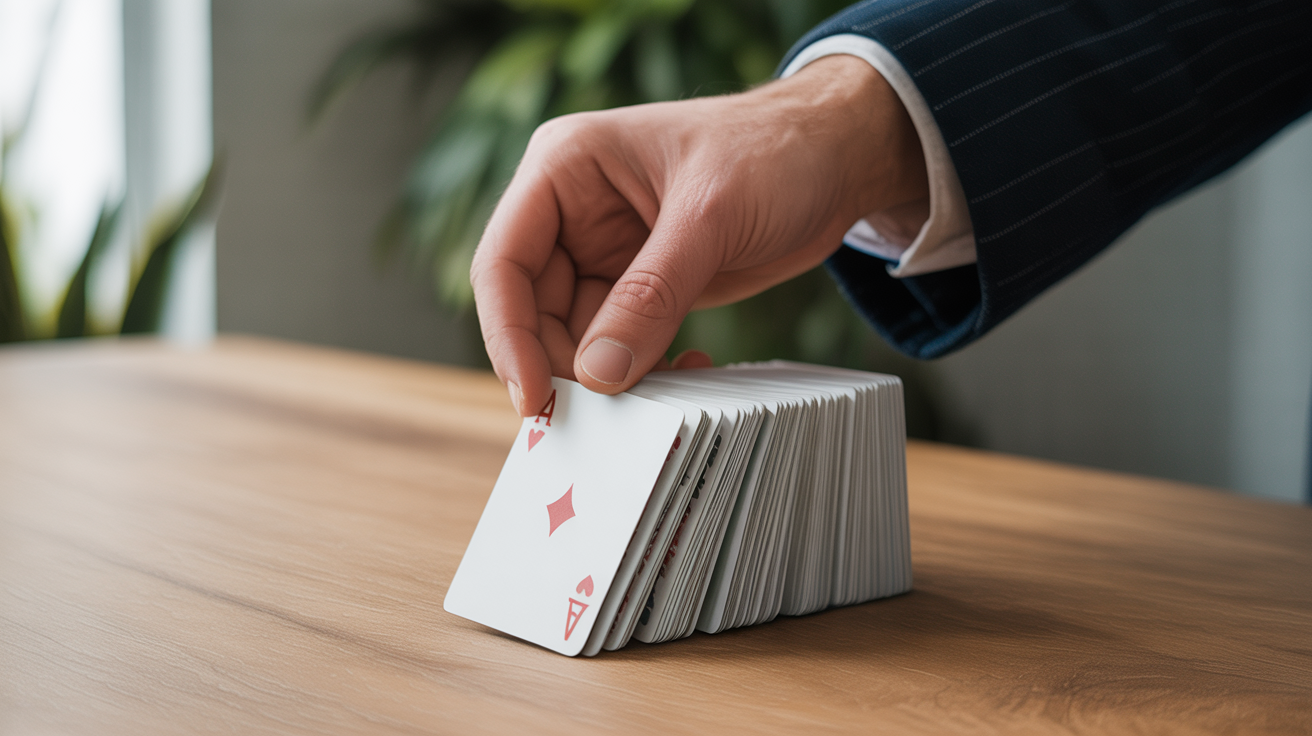
Most spectators trust one thing above almost anything else in card magic: the cut. After all, they watched you divide the deck and swap the halves. That has to mix the cards, right? Not if you know a false cut. A false cut is any sequence of moves that looks exactly like a genuine cut but leaves every card sitting in the same order it started. It is one of the most useful skills a beginning card magician can learn, and it is a lot simpler than it sounds.
What a False Cut Actually Does
When you give the deck a real cut, the top half moves to the bottom, the bottom half moves to the top, and the order changes. A false cut mimics those same motions while secretly returning every packet to its original position before the sequence ends.
That distinction matters a lot in practice. Say you have arranged the top few cards in a specific order for a trick, or you spotted a key card sitting on top. A real cut destroys that setup. A false cut preserves it while giving everyone watching the visual impression that the deck has been genuinely mixed.
Why Beginners Should Learn This Early
You do not need to be an advanced card handler to use a false cut. The version taught here requires no difficult grips, no fast fingers, and no years of practice. What it does require is a clear understanding of the sequence and a bit of time running through the motions until they feel natural and unhurried.
Once you have it, you will use it constantly. It pairs naturally with a key card, lets you maintain a memorized top card during a card force, and serves as a finishing move after a false shuffle to convince an audience the deck is truly randomized.
The Three-Packet False Cut: Step by Step
This version is sometimes called a tabled false cut because it happens on a flat surface. You lift off packets and set them down in a way that looks like standard cutting but reassembles everything in the exact starting order by the final move.
Work through these steps slowly the first few times, paying attention to the running order of the three packets.
Before you begin: Hold the deck face down on the table. The top card is whatever you want to protect. For these instructions, think of the full deck as one block called A-B-C from top to bottom.
-
Lift roughly the top third of the deck with your right hand and set it down a few inches to the right. Call this packet A. You now have two groups on the table: the main block (B-C) on the left, and A on the right.
-
With your right hand, lift the top portion of the remaining left block. This is packet B. Set B down in the middle, between B-C and A. You now have three packets left to right: C on the left, B in the center, A on the right.
-
Here is the move that closes the loop. Pick up packet C (the leftmost group, which was the original bottom of the deck) and place it on top of B. You now have C-B in the center and A on the right.
-
Finally, pick up A and place it on top of C-B. The full deck is now A-C-B... wait. Let us slow down and recheck.
The sequence that works is:
- Cut top third to the right: table now holds [B-C] on the left, [A] on the right.
- Cut top portion of B-C to center: table now holds [C] on the left, [B] in center, [A] on the right.
- Drop C onto B: pick up the left packet C and place it on the center B. Center is now [C on B]. Right is still [A].
- Drop A onto C-B: pick up A and place it on top of [C on B]. Result: A on top, C in the middle, B on the bottom.
That gives you A-C-B, not A-B-C. So there is one more move: when you set A down in step 4, you are actually setting it on the combined stack and squaring everything up into one block. Because B went under C and C went under A, the original order is restored as A-B-C.
The trick is to cut consistent thirds. If your three packets are roughly equal, the reassembly looks convincing. Wildly uneven packets make spectators notice the math does not add up.
A Simpler Alternative: The Swing Cut False Cut
If the three-packet version feels like too much to track, start with this one-move fake cut instead. It works best when you are standing and holding the deck.
- Hold the deck in your left hand in the standard dealing grip.
- With your right hand, swing the bottom half of the deck out to the right, so both halves are face down and side by side in the air.
- Drop the right packet (which was the bottom) into your left hand underneath the left packet (which was the top).
- Square the deck.
Stop right there. That sequence is a real cut. The false version adds one step: before you drop the right packet under the left, you bring the left packet down onto the right packet first, then use your right hand to sweep both underneath the left thumb as one unit. Done smoothly, it looks like a standard swing cut. The order never changes.
This version is harder to do cleanly in the first few tries because the timing of the two-packet reunion happens fast. Slow down until it becomes automatic.
Selling the False Cut to the Audience
Performing the move is only half the job. The other half is making it invisible — not through speed, but through context.
Match the speed of a real cut. The most common mistake beginners make is slowing down during a false cut. The instant you move more carefully than you do when genuinely cutting, something registers as off in the viewer's mind even if they cannot name it. Practice a real cut until you know its natural rhythm, then match that exact rhythm during the false version.
Talk while you cut. Patter is misdirection in its simplest form. Ask the spectator a question, make a comment about the trick, or narrate what you are doing in a relaxed way. When your words give their attention something to land on, the hands become scenery. See the full introduction to sleight of hand for beginners for more on using speech as cover.
Do not repeat it in the same performance. One false cut reads as a genuine cut. Two identical cuts in a row start to look like a pattern. Three and the sharper spectators begin to wonder. Use it once per trick at most, and vary the moment you deploy it.
Angle matters on the table version. When you do the three-packet cut on a table, keep the packets from drifting too far apart. If spectators on the side can see that packet A never actually merged with the rest, the illusion breaks. Keep the cutting zone compact and squared up.
The Mental Checklist Before You Perform
Run through this before you try the false cut in front of anyone:
- Can I do a real cut at the same pace without thinking about it?
- Do I know which packet goes where in the sequence without stopping to recall?
- Am I square and relaxed, or do my shoulders tighten when I start the move?
- Is there a natural moment in the performance where a cut would be expected?
If any of those answers are uncertain, keep practicing in private. The false cut earns its power from being invisible, and invisibility comes from comfort, not cleverness.
Common Mistakes and How to Fix Them
Hesitation at the third packet. This is the most common failure point in the three-packet version. The moment you pause to remember which pile goes where, the audience sees you pause. Fix it by drilling the sequence as one flowing count: one, two, three, done. Do not let your eyes dart between the piles to confirm the order.
Reassembling in the wrong direction. Beginners sometimes reverse the final pickup, which produces a genuine cut by accident. After your session, flip the cards face up and verify the order survived. If the cards are scrambled, walk through the sequence again at half speed to find where the reassembly went wrong.
Cutting uneven packets. A packet that is only three or four cards thick looks strange because real cuts rarely produce slices that thin. Aim for roughly a third of the deck each time. You do not need to count; just train your eye to recognize a reasonable portion.
Not squaring the deck before and after. A loose, sloppy deck during a cut looks amateurish and gives spectators a reason to watch your hands more carefully. Square everything tightly before you begin and again at the end.
Pairing the False Cut With Other Skills
The false cut is almost never the trick itself. It is a support move that protects a setup so another technique can do the real work.
One natural combination: perform a false shuffle first to convince the audience the deck has been thoroughly mixed, then offer to let the spectator cut the cards. Execute your false cut at that point, and the cards remain exactly where you need them. The spectator believes they have participated in randomizing the deck twice. Your setup is intact.
Another strong pairing is with a key card. If you have glimpsed the bottom card and are using it to track a selected card, a false cut lets you appear cooperative without destroying your tracking system. The key card stays in position while the audience believes the deck is completely shuffled and cut. The full method for setting this up is explained in the key card guide.
Used alongside a card force, a false cut lets you cut to a position that looks random but lands exactly where you planned. Once the spectator has taken the forced card, a false cut during the replacement phase keeps the deck organized for whatever comes next.
FAQ
Is a false cut difficult to learn?
The basic three-packet false cut is genuinely beginner-friendly. The moves are not physically demanding. The challenge is memorizing the sequence and then repeating it often enough that it stops feeling mechanical. Most people are comfortable with it after a few focused practice sessions.
How do I know if my false cut is convincing?
Practice it in front of a mirror first to check your rhythm and your angle. Then try it in front of someone who knows nothing about card magic and just ask them whether it looked like a normal cut. If they say yes without hesitation, you are there. If they pause or say "kind of," something in the timing or the packet sizes is drawing attention.
Can I use a false cut on a borrowed deck?
Yes. The false cut requires no setup and works with any standard deck in any condition. It is one of the cleaner moves to use with borrowed cards because there is no marking, no forcing, and nothing to detect.
Does the spectator ever get to cut the cards?
In many routines, yes, and that is part of the performance value of a false cut. You can invite the spectator to cut, then "demonstrate" the cut yourself using the false version. Or you can let them perform a genuine cut and then execute your false cut immediately afterward to restore the order. Some performers even teach the spectator a "magic cut" that is secretly the false cut, making them feel like an active participant.
Should I tell anyone how the false cut works?
No. Part of being a thoughtful magician is keeping your methods private. Explaining how a move works removes the sense of wonder that makes magic worth watching, and it makes it harder to perform the same trick for the same person in the future. Practice in private, perform with care, and let the cut speak for itself.